
The Identical Act and the Divergent Mind
In the cognitive-behavioral understanding of anxiety disorders, behavior is often the primary locus of observation and intervention. Yet, a fundamental clinical insight is that the topography of an action, what it looks like to an outside observer, can be profoundly misleading. Two individuals may perform the exact same behavior, yet the underlying psychological mechanisms, and consequently the long-term learning outcomes for the anxious brain, are diametrically opposed. This is critically evident in the realm of social anxiety, particularly concerning behaviors related to uncertainty and the monitoring of social threat.
Consider a quintessential, realistic scenario: An individual walking through a public park or a quiet office corridor. As they pass a small group of strangers, they hear a burst of laughter. In both versions of this scenario, the individual does not turn their head to look back. The observable behavior is identical: non-checking. However, one act is a subtle but potent form of avoidance, reinforcing the pathology of anxiety. The other is an act of genuine uncertainty tolerance, contributing to its erosion. The distinction lies not in the action, but in the internal architecture of motivation, cognitive meaning, emotional aftermath, and, most importantly, the neurocognitive learning that ensues.
The Echo of Laughter and the Internal Cascade
Alex is walking alone along a path, returning from a lunch break. His mind is lightly preoccupied with an upcoming meeting. As he passes a bench where two people are sitting, he hears clear, sharp laughter. Immediately, a cascade is triggered:
- Bodily Sensation: A jolt of adrenaline, a tightening in the chest, warmth in the face.
- Automatic Thought: “That laughter was about me.”
- Cognitive Process: A rapid, involuntary search for evidence. “My walk? Was I swinging my arms oddly? My hair? Did I just trip slightly on the pavement a moment ago?”
- Urge: An overwhelming, magnetic pull to turn and check the strangers’ faces for confirmation or disconfirmation of the threat.
- Safety Behavior: Alex consciously stiffens his posture, fixes his gaze straight ahead, and accelerates his pace slightly. He does not look back.
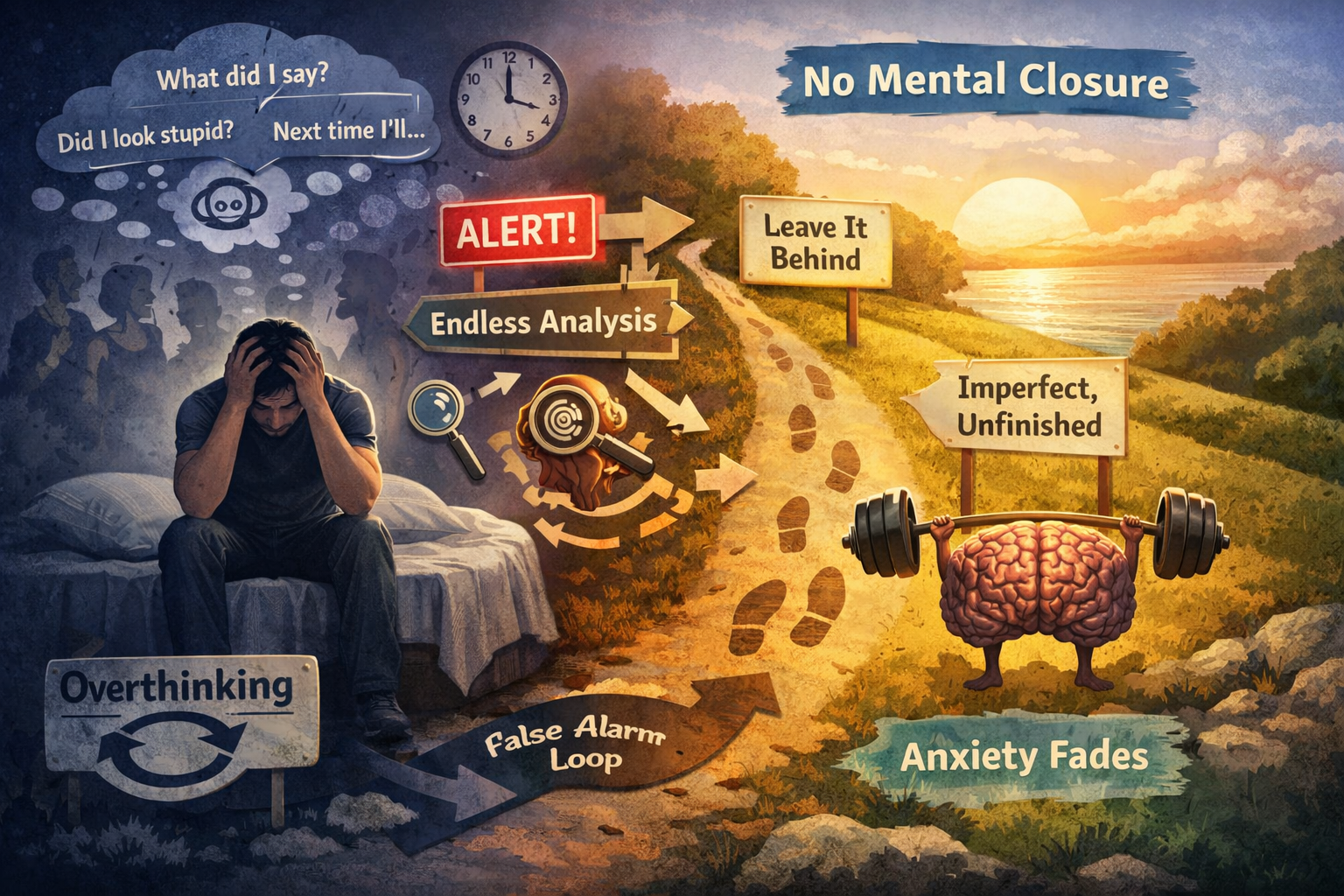
- Post-Event Processing (PEP): For the next hour, the incident replays in a loop. The sound of the laughter is analyzed for tone (mocking? jovial?). The timing is scrutinized. The imagined narratives of the strangers’ conversation are constructed, all converging on a theme of his own perceived deficiency. This mental rumination serves as a covert, internal form of checking, as the brain continues to seek resolution. The downward arrow ultimately points to a core belief: “I am inherently different and defective. I do not belong, and my mere presence is a potential source of ridicule.”
This vignette illustrates the anxious brain’s core imperative: to resolve ambiguity. For Alex, the laughter is not a neutral auditory event; it is a social cue demanding interpretation. The brain’s threat detection system has “tagged” the ambiguity as dangerous, a potential signal of negative evaluation. The belief is that every social cue requires and is worthy of interpretation to ensure social safety.
The Mechanism of Avoidance-Based Non-Checking: The Pursuit of Closure and Relief
When Alex resists the urge to look back due to fear, he is engaging in a sophisticated avoidance behavior. The motivation is threat mitigation.
- Driving Force: Fear and the desire for threat reduction. The primary goal is to escape or avoid the potential of seeing confirming evidence (e.g., seeing them looking at him, pointing, smirking). The perceived risk of turning is catastrophic: direct confirmation of his feared self (“I am laughable”).
- Cognitive Meaning Assigned: The decision not to look is framed as a necessary safety strategy. It means, “Looking would be too dangerous. I am protecting myself from a confirmed threat.” The ambiguity of the laughter remains, but it is now coupled with a narrative of a narrowly-averted disaster.
- Emotional Aftermath & Reinforcement: The dominant subsequent emotion is relief. This relief is powerful and reinforcing. It operates through negative reinforcement: the removal (or avoidance) of an aversive state (potential humiliation) increases the likelihood of the same behavior in the future. The brain learns: “Not checking made the bad feeling (acute fear) go away.”
- The Trap of Confirmation by Omission: Crucially, the relief is misinterpreted as data. The brain infers, “I feel relief because I avoided a real threat.” The ambiguity is not tolerated; it is escaped. However, because the threat prediction (“they are laughing at me”) was never tested, it remains intact and is even strengthened by the “apparent” success of the avoidance. This is sometimes called “confirmation by omission”, the absence of disconfirming evidence is taken as indirect proof of the threat’s validity. The uncertainty is not resolved; it is merely parked, tagged as unresolved danger, and left to fuel future vigilance and PEP.
The Mechanism of Uncertainty-Tolerant Non-Checking: The Acceptance of Irrelevance
Now, imagine an alternative internal pathway following the same auditory stimulus. The initial jolt may occur, the hyper-vigilant amygdala may still fire, but the subsequent cognitive processing diverges radically.
- Driving Force: Irrelevance and intentional disengagement. The individual recognizes the urge to check as a symptom of their anxiety (“my brain is offering me a threat-checking thought”) and makes a values-based or goal-based decision: “Their laughter, regardless of its source, is none of my business. My goal is to get back to my desk. Engaging with this is not useful.”
- Cognitive Meaning Assigned: The decision not to look is framed as active disinterest. It means, “That cue does not warrant my attention or interpretation. Its meaning is ambiguous and irrelevant to my goals.” The individual consciously decouples the external cue from their self-referential threat system.
- Emotional Aftermath & Learning: The dominant subsequent emotion is indifference, or a quick return to baseline. There is no significant relief because there was no perceived escape from a catastrophic threat. There is simply a continuation of the previous mental stream. This is critical for inhibitory learning. The brain has the opportunity to learn something new: that a stimulus (laughter) can be followed by not performing a safety behavior (checking) and not experiencing a catastrophe. The old threat prediction (“If I don’t check, I will remain in danger”) is violated. The new, inhibitory learning is: “Ambiguous social noises do not require my interpretive action.”
A Contrast in Neurocognitive Learning
The difference can be summarized through core learning theory concepts applied to anxiety:
| Aspect | Avoidance-Based Non-Checking | Uncertainty-Tolerant Non-Checking |
|---|---|---|
| Primary Motivation | Fear reduction, escape from perceived threat. | Goal pursuit, disengagement from irrelevant noise. |
| Internal Narrative | “I must not look, or I will see proof I’m being mocked.” | “I choose not to look, as its meaning is not my concern.” |
| Key Emotional Outcome | Relief (negative reinforcement). | Indifference or neutral continuation. |
| Fate of Ambiguity | Ambiguity is escaped but remains, tagged as unresolved threat. | Ambiguity is tolerated and naturally decays due to lack of meaning assignment. |
| Learning Process | Negative Reinforcement: “Not checking removes fear.” Threat prediction remains unchallenged. | Inhibitory Learning: “The world did not collapse when I didn’t check.” New, safe association is formed. |
| Impact on Core Belief | Reinforces defectiveness/social threat belief via “confirmation by omission.” | Weakens the belief by demonstrating its irrelevance to action and outcome. |
| Post-Event Processing | High, ruminative, seeking closure through mental simulation. | Low or none, as the event was not “tagged” as significant. |
The Critical Diagnostic Marker: Relief vs. Indifference
Therefore, the clearest indicator for an individual or a clinician observing their own patterns is not the behavior, but the emotional and cognitive aftermath. The question is not “Did you look back?” but “What happened in your mind and body after you didn’t look?”
- If the result is a palpable sigh of relief, a decrease in acute anxiety, followed by ruminative thoughts, the behavior was avoidance. The brain recorded a narrow escape.
- If the result is a shrug of indifference, a swift return to previous thoughts, or a conscious acknowledgment of irrelevance without emotional upheaval, the behavior was tolerance. The brain recorded a non-event.
Conclusion: Same Behavior, Opposite Learning
The journey towards mitigating social anxiety and its associated constructs, fear of negative evaluation, chronic self-monitoring, and intolerance of uncertainty, requires a microscopic analysis of internal experience, not just external action. The act of not turning towards a source of ambiguous social noise can be a masterclass in either the perpetuation or the dissolution of anxious meaning-making.
When driven by fear and the pursuit of relief, non-checking is a safety behavior that strengthens the brain’s conviction that ambiguity is dangerous and must be resolved. It fuels the false imperative that every social cue is a meaningful referendum on the self. When driven by a conscious choice for disengagement and grounded in the acceptance of irrelevance, the identical behavior becomes a powerful agent of inhibitory learning. It allows ambiguity to exist, untagged and untracked, where it naturally decays, teaching the anxious brain that not all uncertainties are portals to threat, and that a life unburdened by constant interpretation is not only possible but is built one moment of tolerated irrelevance at a time. The outward behavior is a facade; the internal learning environment is where the true, and opposing, transformations occur.