
Introduction
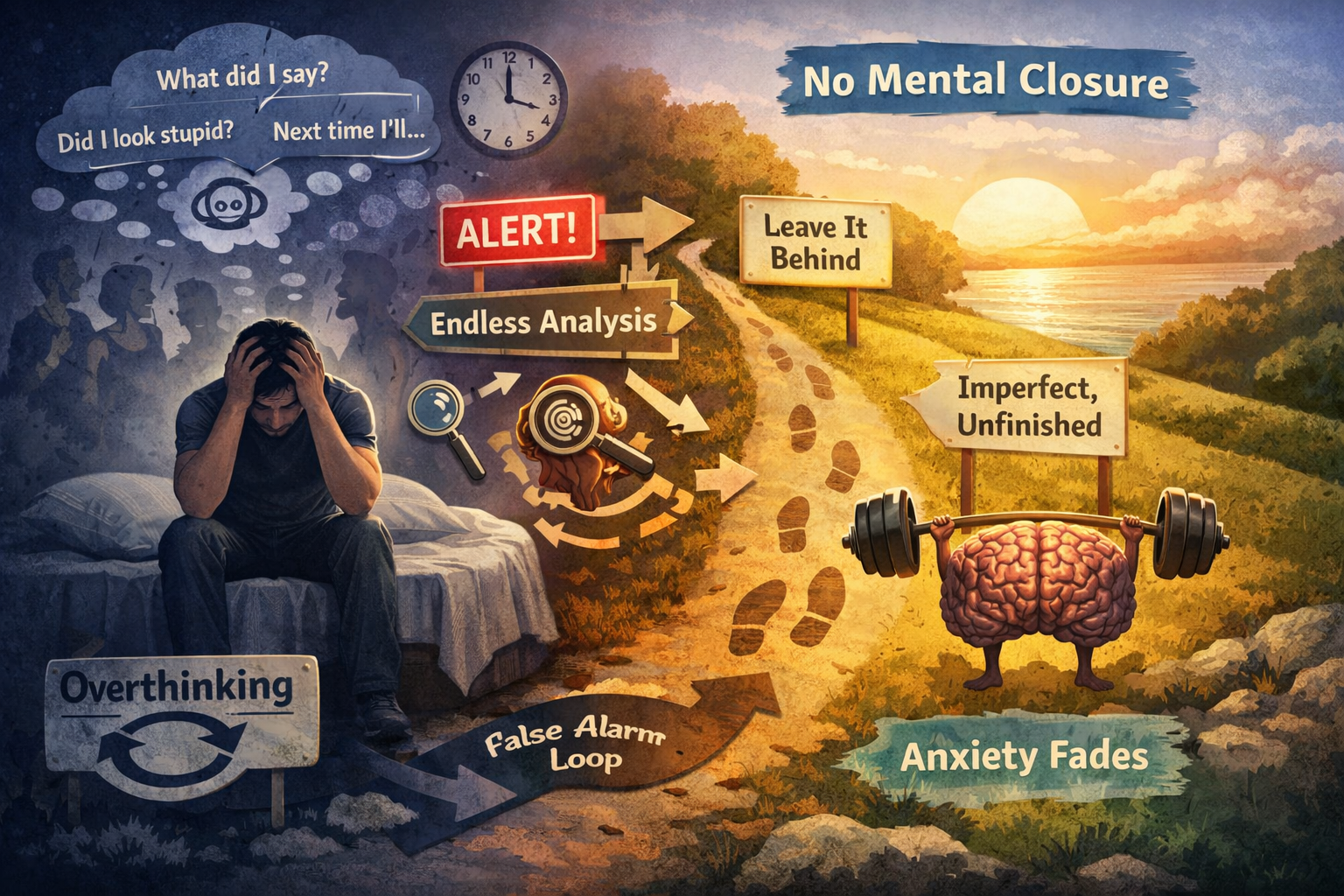
Anxiety is often described as a signal, a mental prompt to prepare, avoid danger, or improve ourselves. Many individuals believe that overthinking, worrying, or replaying events in their mind is a functional way to solve problems or avoid future mistakes. But is this belief accurate? While adaptive forms of worry can help us anticipate challenges, research in cognitive-behavioral science and neuroscience suggests that most anxiety-driven rumination is not only unhelpful, but actively counterproductive. This article critically examines the difference between productive thought and pathological rumination, and why modern models of anxiety treatment emphasize reducing rumination, not enhancing insight, as central to recovery.
The Evolutionary Function of Anxiety, and When It Becomes Maladaptive
Anxiety evolved as a survival mechanism to detect and respond to threat. From an evolutionary perspective, it prioritizes safety by activating physiological and cognitive systems designed to avoid harm.
Adaptive functions of anxiety include:
- Heightened vigilance to potential threats
- Motivated planning or preparation for future challenges
- Activation of fight-or-flight responses in dangerous contexts
However, these systems evolved in environments with immediate, physical dangers. In modern contexts, where threats are often abstract (e.g., social rejection, career uncertainty), the same neural systems become overactive and less effective.
Maladaptive anxiety is characterized by:
- Chronic activation without resolution
- Disproportionate focus on unlikely or uncontrollable outcomes
- Avoidance behaviors that prevent learning and adaptation
This shift from adaptive to maladaptive anxiety marks the difference between helpful worry and clinical conditions like Generalized Anxiety Disorder (GAD) or Social Anxiety Disorder (SAD).
Problem-Solving vs. Rumination: Distinct Cognitive and Neural Patterns
At a surface level, rumination can feel like problem-solving. Both involve sustained attention to difficulties or uncertainties. However, they engage different cognitive processes and neural circuits.
| Feature | Problem-Solving | Rumination |
|---|---|---|
| Goal-Directed | Yes | No |
| Outcome-Focused | Yes | No |
| Flexible Thinking | Present | Absent |
| Emotional Amplification | Minimal | High |
| Brain Activation | Dorsolateral PFC | Medial PFC, default mode network |
Functional neuroimaging studies show that rumination activates the default mode network, a brain system associated with self-referential thought and mental time travel, rather than the executive networks involved in planning and task-solving.
Key takeaway: Rumination sustains negative emotion and self-focus, whereas true problem-solving involves cognitive flexibility and resolution-seeking.
Why Anxious Individuals Overestimate the Value of Thinking More
Many individuals with chronic anxiety hold metacognitive beliefs that worry is protective or productive. For example:
- “If I keep thinking about it, I’ll find the solution.”
- “Worrying shows I care.”
- “If I don’t think it through, something bad might happen.”
These beliefs are reinforced by intermittent relief: when the feared outcome doesn’t occur, the person attributes it to having worried. This is a form of negative reinforcement, where the behavior (rumination) is strengthened because it seems to prevent harm, even if there is no causal link.
Why rumination feels productive:
- It gives a temporary sense of control
- It mimics effortful thinking
- It delays decision-making and emotional exposure
Yet research consistently shows that high levels of worry impair concentration, memory, and emotional regulation, leading to greater distress and fewer adaptive actions.
Rumination, Threat Learning, and Intolerance of Uncertainty
Rumination does more than waste time, it reshapes how the brain processes threat. In anxiety disorders, there is often:
- Increased amygdala activation, amplifying threat detection
- Reduced prefrontal regulation, weakening emotional control
- Persistent post-event processing, especially in social anxiety
In this state, the brain becomes hypervigilant and biased toward danger, even in ambiguous situations.
Rumination reinforces anxiety by:
- Preventing emotional habituation (you never learn the threat isn’t dangerous)
- Strengthening memory for negative outcomes
- Increasing sensitivity to uncertainty
This mechanism is especially clear in Generalized Anxiety Disorder, where worry is chronic and uncontrollable, and in Social Anxiety Disorder, where individuals engage in prolonged post-event rumination that worsens self-perception and avoidance.
Why Modern CBT and ERP Target Rumination, Not Insight
Cognitive Behavioral Therapy (CBT) and Exposure and Response Prevention (ERP) have evolved to prioritize behavioral and attentional change over insight. While understanding one’s patterns can be helpful, change requires disengagement from unproductive thinking loops.
Modern CBT emphasizes:
- Attention training and cognitive defusion
- Exposure to uncertainty without rumination
- Behavioral experiments to test metacognitive beliefs
ERP in anxiety treatment focuses on response prevention, i.e., not engaging in rumination or avoidance after exposure to a trigger. This leads to new learning, where the brain updates its threat associations and tolerates ambiguity.
Key principle: Rumination is not neutral, it is an active process that blocks recovery by maintaining anxiety pathways. Reducing rumination enables the brain to unlearn fear and tolerate distress without compulsive thought.
The Counterintuitive Nature of Recovery
It is common for anxious individuals to resist the idea that “thinking less” could help. The strategy feels unsafe, irresponsible, or lazy. But this discomfort is part of the problem: anxiety disorders are maintained by efforts to eliminate uncertainty through overthinking.
Recovery requires:
- Accepting thoughts as mental events, not problems to solve
- Interrupting the mental rituals of worry and rumination
- Learning through experience, not over-analysis
This is counterintuitive, but well-supported. Meta-analyses show that reductions in worry and rumination predict long-term improvement, even when insight remains limited.
Conclusion
Anxiety and rumination feel useful because they create a sense of control, not because they lead to better outcomes. While adaptive worry can guide preparation, most chronic anxious thinking impairs emotional regulation, learning, and functioning. Rumination sustains anxiety by reinforcing threat associations and intolerance of uncertainty, especially in disorders like GAD and SAD. Modern CBT targets this mechanism directly, not by solving the content of thoughts, but by disengaging from the process itself. Understanding this may feel paradoxical, but it reflects the core principle of effective anxiety treatment: less mental effort often leads to more psychological freedom.
References
McEvoy, P. M., Watson, H., Watkins, E. R., & Nathan, P. (2013). The relationship between worry, rumination, and comorbidity in generalized anxiety disorder and major depressive disorder. Behaviour Research and Therapy, 51(6), 261–267.
Borkovec, T. D., & Inz, J. (1990). The nature of worry in generalized anxiety disorder: A predominant verbal activity. Behaviour Research and Therapy, 28(2), 153–158.
Nolen-Hoeksema, S., Wisco, B. E., & Lyubomirsky, S. (2008). Rethinking Rumination. Perspectives on Psychological Science, 3(5), 400–424.
Clark, D. M., & Wells, A. (1995). A cognitive model of social phobia. In R.G. Heimberg et al. (Eds.), Social Phobia: Diagnosis, Assessment, and Treatment.
Hofmann, S. G., Asnaani, A., Vonk, I. J., Sawyer, A. T., & Fang, A. (2012). The Efficacy of Cognitive Behavioral Therapy: A Review of Meta-analyses. Cognitive Therapy and Research, 36(5), 427–440.