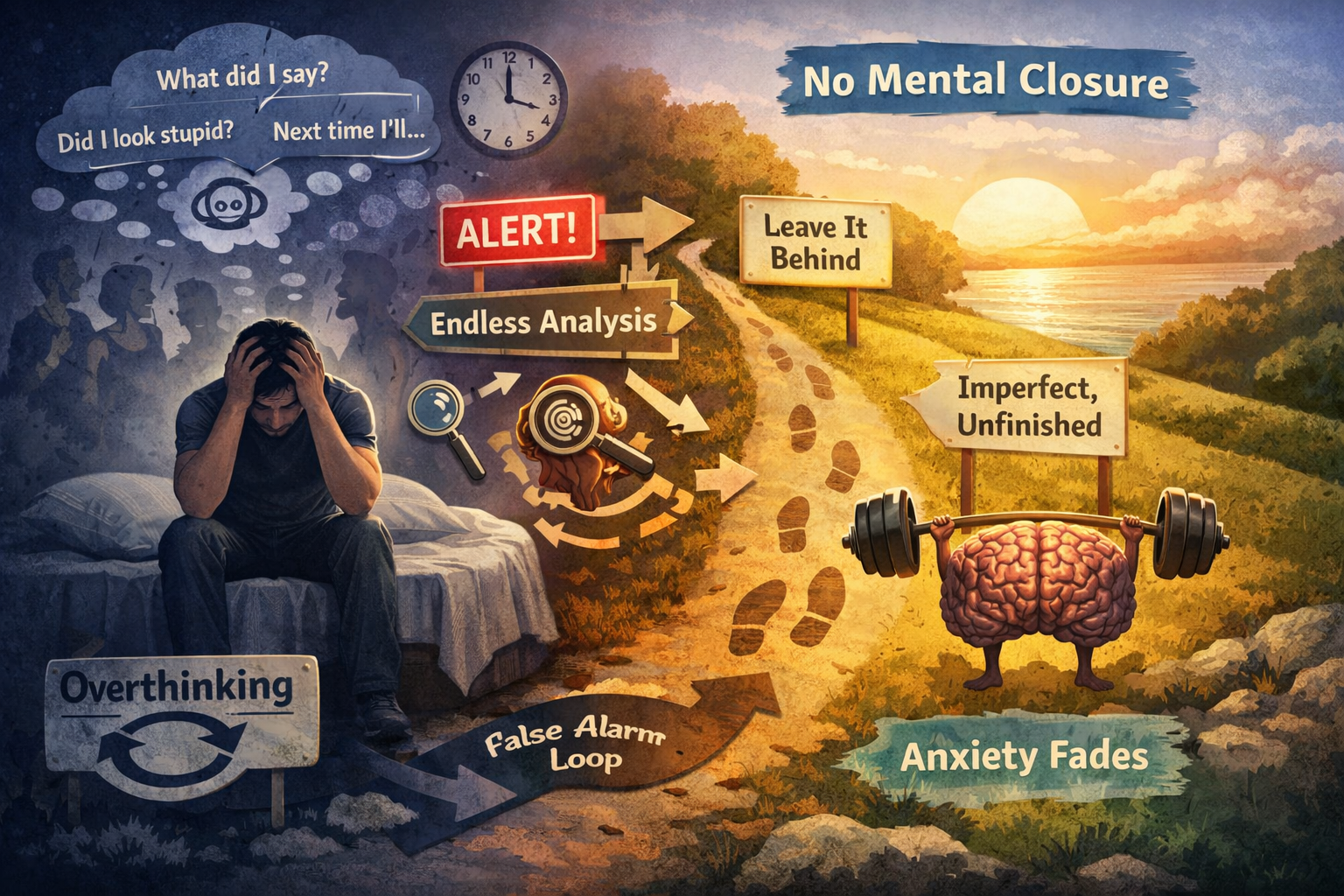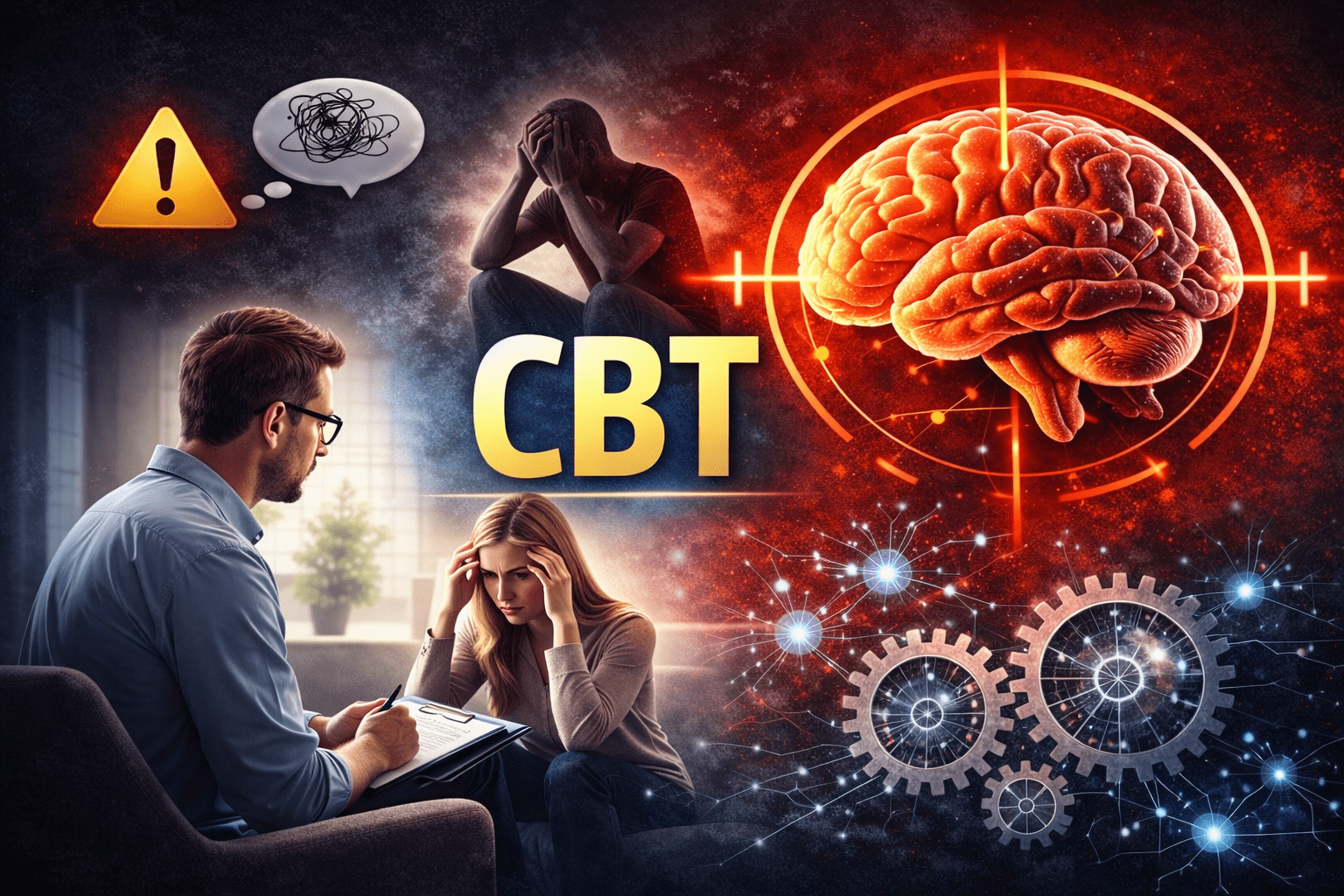

Anxiety is not just a feeling, it’s a complex interplay of neurocognitive mechanisms designed to keep us safe. But when those systems misfire, they can trap individuals in a cycle of overthinking, avoidance, and hypervigilance. For analytically minded people who value understanding over platitudes, the question becomes: which interventions work, and why?
Cognitive Behavioral Therapy (CBT) has been repeatedly validated across hundreds of trials as the gold standard for anxiety disorders. But this article goes deeper: explaining why CBT works mechanistically, from neurocognitive appraisal to behavioral reinforcement, and why it continues to outperform other methods in both efficacy and durability.
What Anxiety Disorders Really Are: Mechanistic Roots
Anxiety disorders are not just about “feeling stressed.” They are persistent, maladaptive patterns involving threat misappraisal, avoidance learning, and distorted safety calculations. Four central mechanisms underlie most anxiety disorders:
1. Threat Overestimation:
The brain’s threat-detection system (amygdala, insula) becomes hypersensitized. It overestimates danger, interpreting ambiguous cues as high risk. Even low-probability events are appraised as likely and catastrophic.
2. Avoidance Learning:
Avoidance offers short-term relief from fear but reinforces the perception of danger. By never confronting the feared outcome, the brain never gets to update its predictions.
3. Safety Behaviors:
Subtle, often unconscious actions (e.g. rehearsing conversations, sitting near exits) prevent disconfirmation of threat. They reduce distress in the moment but maintain anxiety in the long run.
4. Cognitive Distortions:
Biased interpretation patterns, like catastrophizing, mind-reading, or black-and-white thinking, sustain anxiety by skewing reality in the direction of perceived threat.
These components interlock into a self-perpetuating loop. Anxiety remains high because the brain is never given corrective feedback. CBT is specifically designed to break this loop.
Why Confidence, Motivation, and Pure Mindfulness Approaches Fall Short
Many well-intentioned interventions focus on increasing confidence, positive thinking, or general emotional regulation. But they often miss the root.
- Confidence coaching assumes that lack of self-belief is the core problem. In reality, anxious individuals often know their fear is irrational, but can’t change it because the system reinforcing the fear (avoidance + safety behaviors) is intact.
- Mindfulness-only approaches increase present-moment awareness but do not systematically challenge cognitive distortions or disrupt avoidance learning. While helpful in reducing baseline arousal, they lack the structured corrective mechanisms CBT provides.
- Emotional regulation or motivational tactics aim to soothe distress, but soothing doesn’t equal learning. Anxiety is maintained by prediction errors not being updated, which requires exposure and cognitive restructuring, not just comfort.
In short: anxiety isn’t just an emotional problem. It’s a learning problem, and CBT is a learning-based solution.
How CBT Works: Core Mechanisms of Change
CBT directly targets the systems that create and maintain anxiety disorders. It is a dual-process intervention, working on both cognitive interpretation and behavioral reinforcement.
Cognitive Appraisal and Interpretation
CBT teaches clients to identify and challenge distorted interpretations. Using guided discovery, Socratic questioning, and evidence evaluation, patients learn to generate more realistic appraisals of threat.
Example: A person with social anxiety might think “If I say something stupid, everyone will think I’m an idiot.” CBT helps them examine: What evidence supports this? Have people reacted that way before? Are there alternative explanations?
This is not just thought replacement, it’s prediction recalibration.
Cognitive Distortions and Threat Bias
CBT identifies specific distortions:
- Catastrophizing – expecting the worst
- Fortune-telling – predicting failure without evidence
- Mind reading – assuming others think negatively
- Selective abstraction – focusing only on threat-relevant details
The therapist helps patients notice and reframe these distortions repeatedly, weakening their automaticity over time. fMRI studies (e.g., Ochsner & Gross) have shown reduced amygdala activation when reappraisal strategies are applied, supporting CBT’s neurobiological basis.
Behavioral Avoidance and Safety Behaviors
Avoidance prevents new learning. CBT uses behavioral experiments to reverse this process. Clients test feared predictions in real-world scenarios, allowing the brain to experience violated expectations, the foundation of belief updating.
Safety behaviors (e.g., always carrying water, texting for reassurance) are also identified and gradually removed to allow disconfirmation.
Exposure and Inhibitory Learning
Contrary to popular belief, exposure therapy is not about “toughing it out.” It is about maximizing prediction error, presenting feared stimuli without the feared outcome, allowing the brain to build a new non-threat association.
This process is called inhibitory learning (Craske et al.). Instead of “unlearning” fear, the brain forms new pathways that inhibit the old fear response.
Nervous System Retraining through Prediction Error
Anxiety is maintained when the brain predicts danger and is never corrected. CBT works by creating precisely engineered violations of prediction. When the predicted catastrophe doesn’t occur, the brain updates its model, recalibrating both emotional and physiological responses.
This is learning at the neural level, a form of supervised error correction.
CBT vs. Other Approaches: Why It Outperforms
Mindfulness-only
Helps with attention and stress tolerance, but doesn’t actively challenge threat appraisals or avoidance. Works best as an adjunct to CBT, not a replacement.
Emotion Regulation Approaches
Focus on coping (deep breathing, distraction). These reduce arousal but don’t rewire the threat learning system. Useful in acute moments but not curative.
Confidence/Self-Esteem Coaching
Often misidentifies the problem. Anxiety persists even in highly competent individuals if core fear structures remain unchallenged.
CBT integrates cognition, behavior, and emotional learning, making it the only model that targets all major maintenance mechanisms of anxiety.
Specific Disorders Where CBT Is First-Line
- Social Anxiety Disorder:
CBT (Clark & Wells model) disrupts self-focused attention, challenges distorted social predictions, and eliminates subtle avoidance (e.g., overpreparing, avoiding eye contact). - Panic Disorder:
CBT corrects catastrophic misinterpretations of bodily sensations (e.g., “heart racing = heart attack”) through interoceptive exposure and cognitive restructuring. - Generalized Anxiety Disorder (GAD):
CBT addresses intolerance of uncertainty and cognitive overcontrol. Worry is treated as a failed problem-solving strategy, not a symptom to be soothed. - Specific Phobias:
Systematic exposure therapy leads to rapid extinction of fear response through repeated prediction error. - Obsessive Compulsive Disorder (OCD):
Though requiring more specialized techniques (ERP), CBT still forms the backbone. Exposure combined with response prevention breaks the compulsion loop.
Common Misconceptions About CBT
- “CBT is just positive thinking” – False. CBT focuses on realistic thinking, not forced optimism.
- “CBT ignores emotions” – CBT changes emotion through cognitive and behavioral learning, not suppression.
- “CBT is superficial” – It targets deep learning systems via structured, mechanistic processes.
- “CBT doesn’t work if I already know my thoughts are irrational” – Insight is not change. CBT bridges the gap between knowledge and behavior through experience-based learning.
Conclusion: Why CBT Remains the Gold Standard
CBT is not popular because of marketing, it’s the gold standard because it targets the fundamental mechanisms that create and maintain anxiety. It retrains the nervous system through exposure, corrects cognitive distortions through reappraisal, and breaks avoidance cycles behaviorally.
It is:
- Mechanistically sound
- Empirically validated
- Durable in effect
- Adaptable to various disorders
For those who want to understand how anxiety works, and how it can be unlearned, CBT offers not just answers, but tools.
References
- Beck, A. T. (1976). Cognitive Therapy and the Emotional Disorders. International Universities Press.
- Clark, D. M., & Wells, A. (1995). A cognitive model of social phobia. In Heimberg et al. (Eds.), Social Phobia: Diagnosis, Assessment, and Treatment.
- Hofmann, S. G., Asnaani, A., Vonk, I. J., Sawyer, A. T., & Fang, A. (2012). The Efficacy of Cognitive Behavioral Therapy: A Review of Meta-analyses. Cognitive Therapy and Research, 36(5), 427–440.
- Craske, M. G., Treanor, M., Conway, C. C., Zbozinek, T., & Vervliet, B. (2014). Maximizing exposure therapy: An inhibitory learning approach. Behaviour Research and Therapy, 58, 10–23.
- Ochsner, K. N., & Gross, J. J. (2005). The cognitive control of emotion. Trends in Cognitive Sciences, 9(5), 242–249.
- American Psychological Association. (2023). Clinical Practice Guideline for the Treatment of Anxiety Disorders.
- National Institute for Health and Care Excellence (NICE). (2020). Generalised anxiety disorder and panic disorder in adults: management.