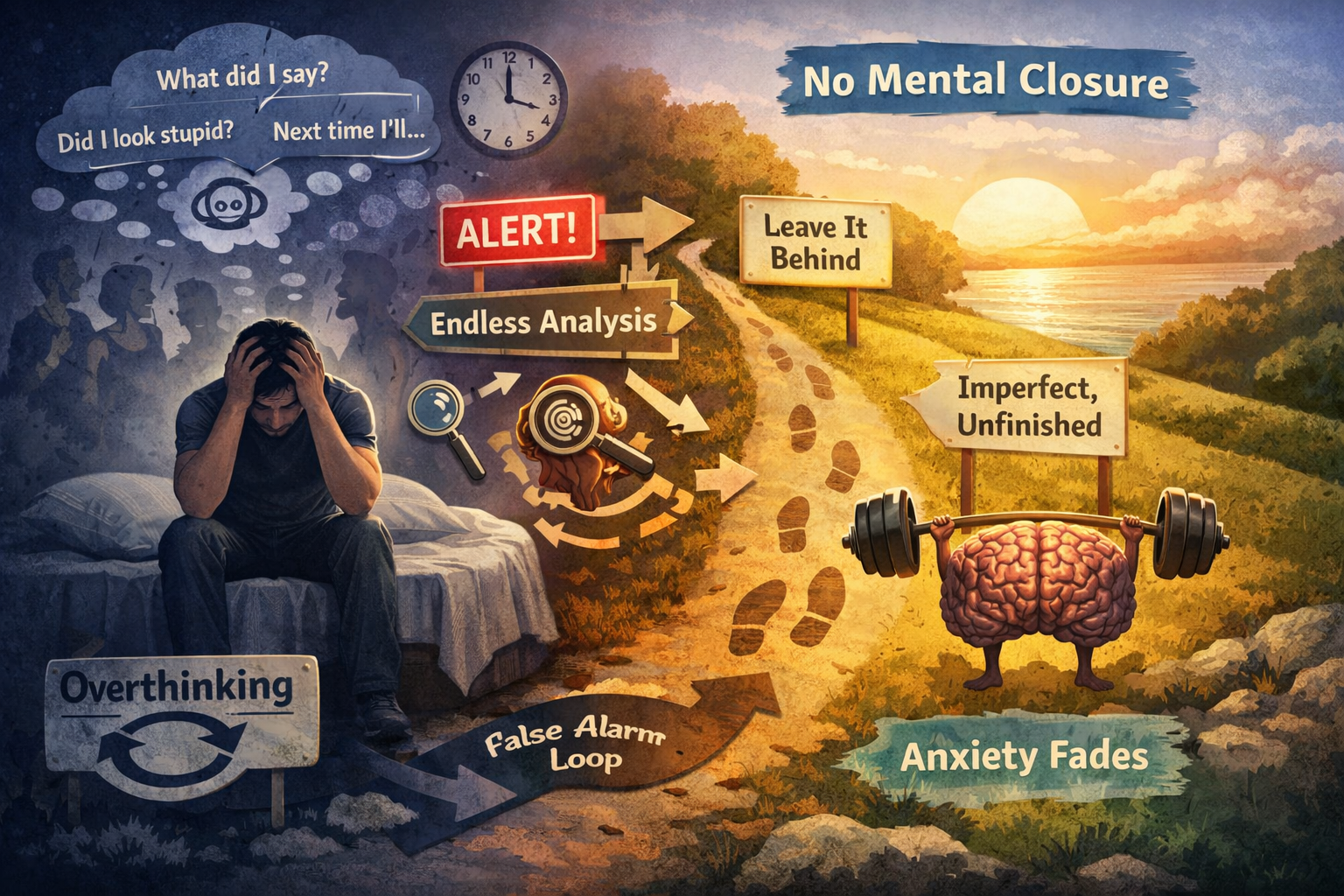

Anxiety disorders are not defined by the frequency of negative events in a person’s life. They are defined by how the nervous system assigns significance to those events. The central distortion is not necessarily factual misinterpretation, but amplified meaning attribution. A neutral or mildly negative occurrence becomes neurologically encoded as high-impact, high-threat, and high-identity relevance. The suffering that follows is driven less by the event itself and more by the conditioned reaction to it.
Understanding this distinction is foundational for effective treatment.
Objective Impact vs. Conditioned Reaction
Anxiety operates through threat learning. Over time, the nervous system pairs certain cues with danger, embarrassment, rejection, or loss. Once conditioned, the response can become disproportionate to the stimulus.
A useful model:
- Objective impact: 0–2
- Nervous system reaction: 7–9
- Experienced suffering: reaction-driven
For example, someone laughs nearby. Objectively, impact may be negligible. Yet in social anxiety, the nervous system may encode: “This signals humiliation.” The body mobilizes as if status, belonging, or safety is at stake. The suffering is not produced by the laugh; it is produced by the conditioned meaning assigned to it.
This distinction is central in both cognitive-behavioral and exposure-based frameworks. The nervous system responds to prediction, not objective reality. When threat prediction is exaggerated, meaning becomes inflated.
Rumination Duration as a Marker of Neural Change
Individuals often measure recovery by emotional intensity: “Did I feel anxious?” A more valid marker of neural recalibration is duration of rumination.
Research on worry (Borkovec) and rumination (Nolen-Hoeksema) shows that prolonged cognitive engagement sustains physiological arousal through negative reinforcement. The mind attempts to resolve uncertainty, but in doing so, it reactivates threat circuitry repeatedly.
Rewiring is better reflected by:
- Faster recovery after activation
- Reduced time spent mentally replaying events
- Quicker return to baseline functioning
Intensity may persist temporarily during recovery. Duration shortens first. Neural recalibration reduces how long the system remains activated, not necessarily whether activation occurs.
Functioning While Distressed: High-Value Exposure
Exposure-based models, particularly Craske’s inhibitory learning framework, emphasize that new learning occurs when feared outcomes fail to materialize during activation.
Functioning while anxious produces:
- Prediction error: “I expected catastrophe; it did not occur.”
- Inhibitory learning: new non-threat associations compete with fear memory.
- Reduced negative reinforcement: avoidance no longer maintains fear.
The goal is not emotional elimination. It is this sequence:
Trigger → feel → settle → continue functioning.
Continuing behavior during distress signals safety to the nervous system. This is exposure in its most potent form.
Cognitive Reappraisal vs. Fear Memory Updating
Cognitive restructuring reduces threat prediction by modifying interpretations. It is effective at lowering conscious threat appraisal.
However:
- Reappraisal works primarily at the level of belief.
- Exposure updates associative fear memory networks.
Memory reconsolidation research suggests durable change requires:
- Activation of the emotional memory
- A mismatch (prediction error)
- Emotional safety during the mismatch
Without activation, no updating occurs. This explains why cognitive restructuring alone may not fully resolve deep shame or humiliation layers. Beliefs may shift, yet somatic threat responses persist.
ERP remains the non-negotiable foundation because it engages the fear circuitry directly.
Anger as a Defensive Shield Against Shame
In humiliation-triggered social anxiety, anger often masks shame. Anger restores perceived status and psychological strength. Shame signals status loss and social devaluation; anger counteracts that vulnerability.
Laughter triggers frequently combine:
- Perceived status threat
- Schema activation from childhood memories
- Attachment-related insecurity
The present cue activates older memory networks. The reaction feels immediate, but it is layered with historical echoes.
Schema Activation and “Inner Child” Reframed
What is often called “inner child work” can be reframed scientifically as schema updating within memory networks. Early experiences form schemas about worth, status, and belonging. When triggered, these schemas bias interpretation automatically.
Schema Therapy maps these identity-level distortions. EFT can target humiliation-based core pain. REBT addresses rigid “must” beliefs that intensify perceived failure (“I must never look foolish”).
CBT alone may reduce surface-level distortions, but identity-linked shame schemas require deeper emotional processing.
Recalibration vs. Regression
During recovery, increased emotional sensitivity may occur. This is recalibration, not regression. The nervous system is learning new threat thresholds. Temporary fluctuations reflect instability in competing memory traces, not failure.
Inhibitory learning competes with old fear networks; it does not erase them.
Internal Status and Non-Fragile Identity
Status sensitivity is biologically embedded. However, when identity becomes fragile, minor cues trigger disproportionate alarm.
Protective constructs include:
- Internalized self-worth independent of evaluation
- Flexible self-concept
- Reduced absolutist beliefs
REBT’s focus on “must” statements directly weakens rigid identity conditions.
Self-Soothing as Attachment Repair
Self-soothing is not avoidance. It is attachment regulation. When emotional activation occurs, providing internal safety cues reduces amygdala-driven threat amplification (LeDoux).
Emotional safety during activation is necessary for reconsolidation. Without safety, exposure becomes retraumatizing rather than corrective.
Why ERP Is Foundational
Exposure and response prevention interrupts negative reinforcement loops. Avoidance maintains inflated significance by preventing disconfirmation.
ERP:
- Activates fear memory
- Allows mismatch with catastrophic prediction
- Builds inhibitory learning
Other modalities refine emotional and identity-level layers, but ERP addresses the conditioning core.
The End Goal: Fast Recovery, Not Zero Emotion
Psychological freedom is not the absence of activation. It is the reduction of magnified meaning.
Real event ≠ magnified significance.
Recovery reflects nervous system recalibration. The sequence becomes efficient:
Trigger → feel → settle → continue.
The event remains small. The reaction becomes proportional. Identity remains intact.
Anxiety treatment, at its most rigorous, is not personality change. It is threat-learning recalibration.
References
Borkovec, T. D. (Worry and generalized anxiety disorder research)
Nolen-Hoeksema, S. (Rumination theory)
Clark, D. M., & Wells, A. (Cognitive model of social anxiety)
Hofmann, S. G. (CBT mechanisms of change)
Craske, M. G. et al. (Inhibitory learning model of exposure)
LeDoux, J. (Fear circuitry and emotional processing)
Research on memory reconsolidation (Nader, Schiller, Phelps)
Contemporary literature on shame and schema activation