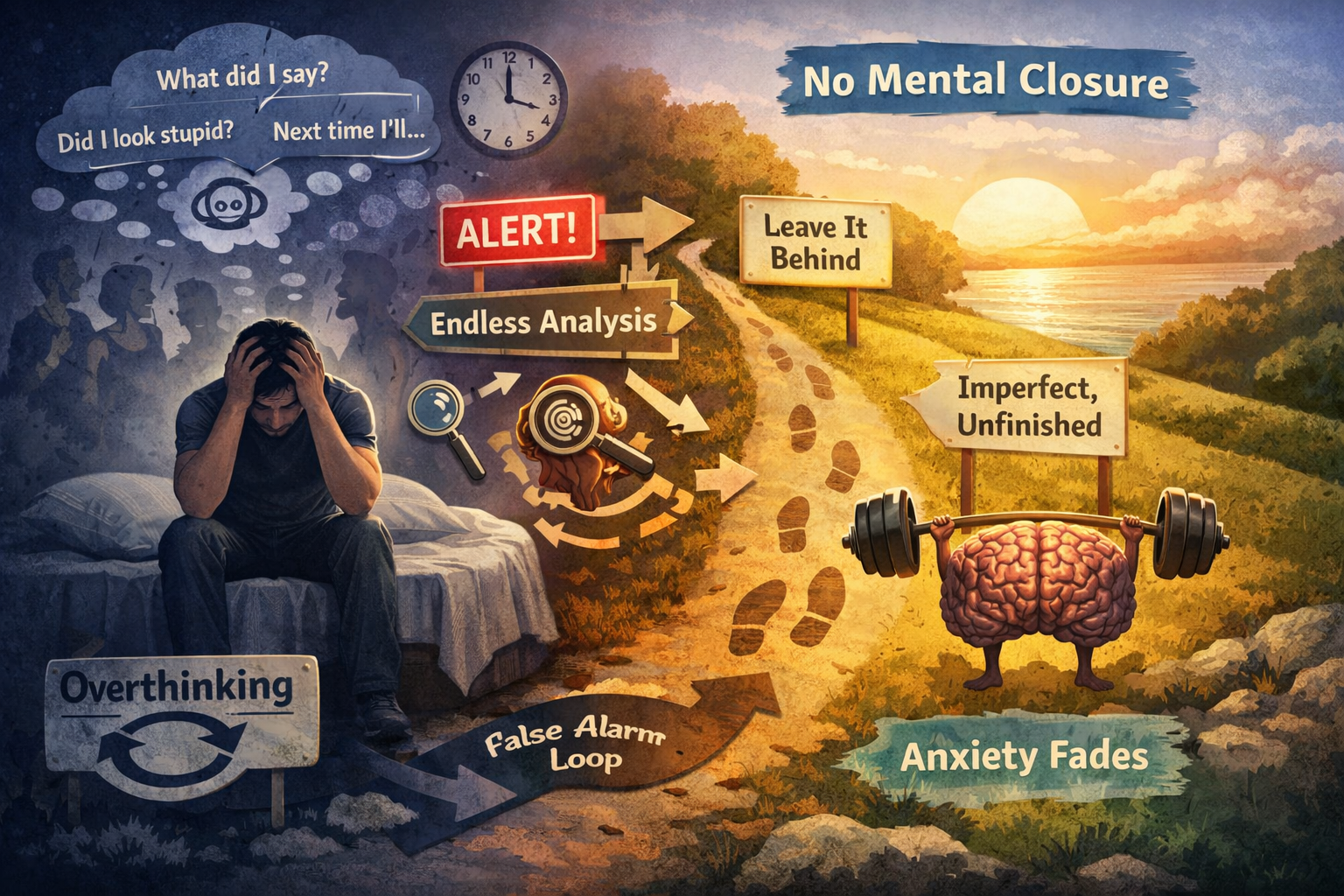

If you have Generalized Anxiety Disorder (GAD) or Social Anxiety Disorder (SAD), you already know what overthinking feels like.
It’s constant. Relentless. Exhausting.
But what most high-functioning, analytical adults miss is this:
Your anxiety isn’t just driven by fear.
It’s driven by shame.
Not loud, dramatic shame.
Quiet, internal, self-directed shame.
The kind that sounds like:
“Why did you say that?”
“You should have known better.”
“They think you’re incompetent.”
“You’re too much.”
“You’re not enough.”
That voice doesn’t feel emotional. It feels rational. Responsible. Protective.
It isn’t.
It’s the engine keeping your anxiety alive.
Anxiety Isn’t Just About the Future
In GAD, the mind scans for potential problems. In social anxiety, it scans for potential judgment. Both disorders revolve around threat detection.
But here’s what often goes unnoticed:
The threat isn’t only external.
It’s internal.
For many intelligent, self-aware adults, the most aggressive source of criticism isn’t other people. It’s themselves.
You try to prevent embarrassment by mentally rehearsing conversations.
You try to avoid failure by anticipating every possible mistake.
You replay social interactions to identify “what went wrong.”
On the surface, this looks like problem-solving.
Underneath, it’s self-attack.
And your nervous system doesn’t distinguish between external criticism and internal criticism. It only registers danger.
When you attack yourself, your body reacts as if someone else is attacking you.
Heart rate increases.
Muscles tense.
Thoughts accelerate.
Anxiety spikes.
Then you criticize yourself for being anxious.
And the loop tightens.
How Shame Fuels the Anxiety Cycle
Shame is the emotional belief that something is wrong with you, not just that you made a mistake, but that you are the mistake.
Self-criticism is shame’s voice.
It says:
“If I punish myself first, no one else will.”
“If I find the flaw, I can fix it before they see it.”
“If I stay hyper-aware, I’ll stay safe.”
But this strategy backfires.
The more you criticize yourself to prevent rejection, the more your nervous system stays in threat mode. And a nervous system in threat mode produces more anxious thoughts.
You feel anxious → you attack yourself for being weak → your body feels more threatened → anxiety increases → you attack harder.
It feels like you’re trying to gain control.
In reality, you’re reinforcing danger.
Why High-Functioning Adults Get Stuck Here
If you’re analytical and high-achieving, self-criticism probably helped you succeed.
It pushed you.
Refined you.
Sharpened you.
But what once functioned as motivation has turned into chronic internal hostility.
You may even believe:
“If I stop criticizing myself, I’ll become lazy.”
“If I’m not hard on myself, I’ll fail.”
“If I go easy on myself, I’ll lose my edge.”
That belief keeps the critic in power.
And as long as the critic runs the system, anxiety stays activated.
The Turning Point: The Two-Chair Method
Emotion-Focused Therapy offers a powerful intervention for this dynamic: the Two-Chair method.
It sounds simple. It’s not.
In one chair, you sit as the inner critic.
This is the voice that calls you awkward, incompetent, disappointing, weak. You let it speak fully. Clearly. Directly.
In the other chair, you move into the part of you that receives those attacks, the anxious, ashamed, exhausted part.
And then something critical happens:
You respond.
Not intellectually. Emotionally.
You say:
“When you call me incompetent, I feel small.”
“When you attack me after every conversation, I feel defeated.”
“You think you’re protecting me, but you’re hurting me.”
This separation is transformative.
Because most people fused with anxiety believe the critic is their rational self.
When you physically separate the critic from the experiencing self, you expose it as a part — not the truth.
And once it’s a part, it can be challenged.
What Actually Changes
The goal isn’t to silence the critic overnight.
The goal is to weaken its authority.
When the attacked part of you expresses anger, hurt, or sadness toward the critic, shame begins to shift.
You realize:
The critic isn’t strength.
It’s fear wearing armor.
And often, beneath that critic is an older protective strategy formed in environments where mistakes felt dangerous.
When you see that clearly, something powerful happens.
Your nervous system no longer experiences self-reflection as assault.
And when self-reflection is no longer assault, anxiety decreases.
Not because you “think more positively.”
But because you stop being the threat.
The Hard Truth
You cannot calm anxiety while continuing to internally bully yourself.
You cannot feel safe while living with an internal attacker.
And you cannot out-think shame.
You have to confront it directly.
That’s what the Two-Chair method does. It brings the internal war into the open.
And when the war is visible, it becomes negotiable.
The Real Shift
Anxiety disorders are often treated as cognitive problems.
But for many high-functioning adults, they’re relational problems, a broken relationship with themselves.
Repairing that relationship doesn’t make you soft.
It makes you regulated.
And a regulated nervous system doesn’t need constant hypervigilance to survive.
Anxiety feeds on self-attack.
It weakens when the attack stops.
The voice in your head isn’t the enemy.
But unchecked, it becomes one.
And the moment you turn toward it instead of obeying it, the balance of power shifts.