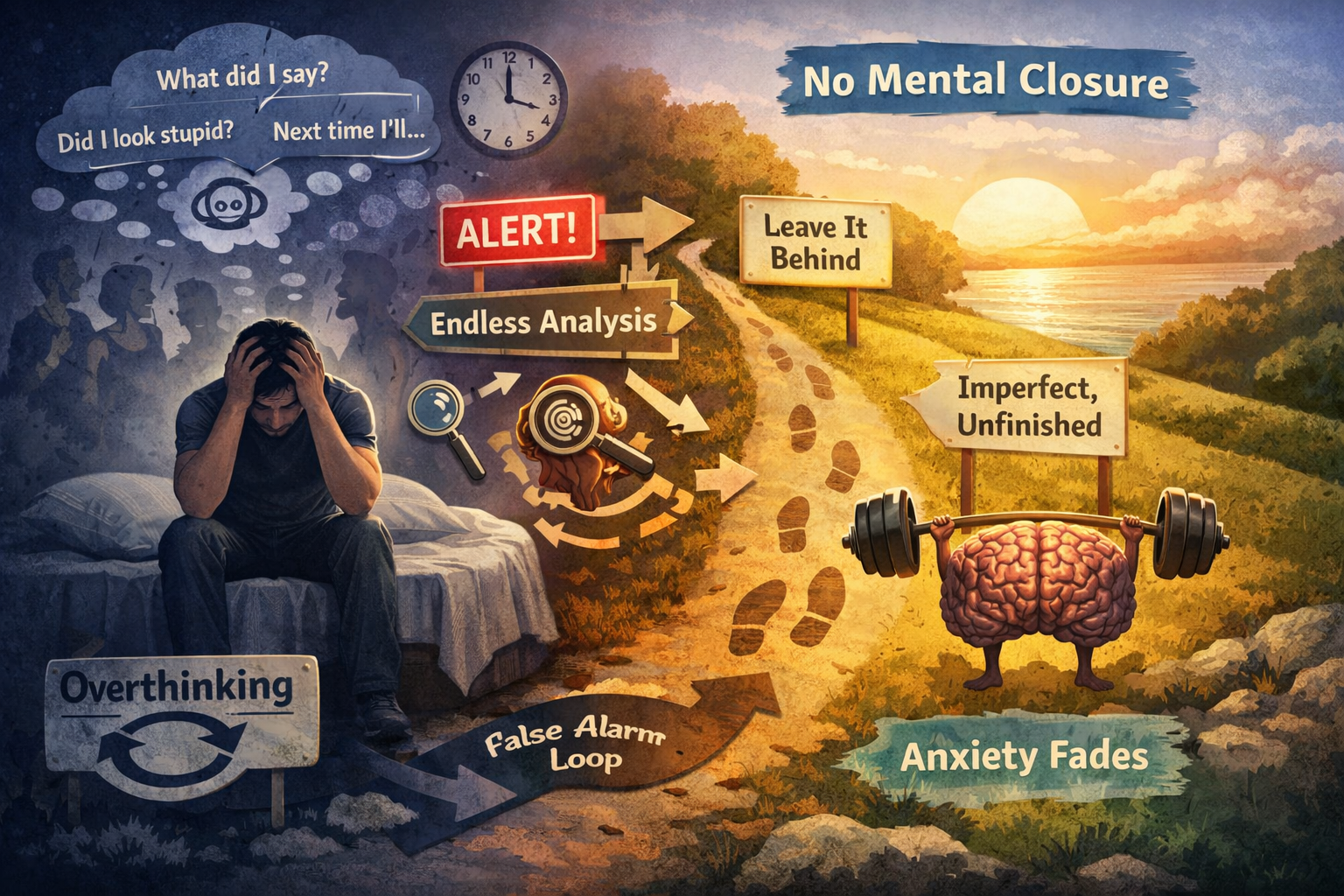

Anxiety disorders such as social anxiety disorder (SAD) and generalized anxiety disorder (GAD) are not primarily problems of having “bad thoughts” or insufficient coping skills. They are disorders of how the brain learns, responds to uncertainty, and maintains threat‑sensitivity over time. A pervasive feature across anxiety presentations is compulsive searching for explanations, certainty, and mental solutions—especially after social events, mistakes, or ambiguous interactions. This search feels rational and self‑improving, yet it functions as a maintenance mechanism that strengthens fear circuits.
This article synthesizes modern cognitive‑behavioral science to explain why the distressing cycle of rumination, post‑event processing, and intolerance of uncertainty persists, and why recovery requires changing the brain’s response to uncertainty—not mastering performance or controlling thoughts.
Why the Anxious Brain Demands Solutions and Certainty
Anxiety, at its core, reflects overactive threat learning. The brain’s threat detection systems evolved to detect and respond to danger—originally physical, now often abstract (social evaluation, future risk). Two neurological and cognitive tendencies are central:
- Amygdala‑based threat learning: The amygdala assigns significance to cues predictive of threat. Overgeneralization and sensitization mean neutral or ambiguous stimuli can evoke threat responses.
- Intolerance of uncertainty (IU): IU is a dispositional bias where unpredictable outcomes are experienced as unacceptable. The brain erroneously treats uncertainty like threat, chemical and cognitive arousal follows.
These mechanisms drive the urge to solve or close uncertainty:
- Did I embarrass myself?
- What did they think of me?
- How could I have done better?
These questions trigger post‑event processing and rumination, which feel purposeful but are actually anxiety’s attempt to control an inherently uncontrollable future. The paradox is that certainty is impossible in social and many real‑world domains; yet anxiety treats uncertainty as if it were danger.

Post‑Event Processing and the Illusion of Mental Closure
In social anxiety and GAD, a common pattern emerges after events: the mind loops through interpretations, imagined outcomes, and hypothetical corrections. This is most clearly captured in:
Post‑Event Processing (PEP)
PEP refers to repetitive cognitive review following a social interaction, mistake, or perceived threat. Research shows that individuals with SAD engage in prolonged mental reviews of social events, focusing on flaws and imagined judgments. Rather than clarifying reality, this cognitive rumination:
- Amplifies negative self‑appraisals
- Reinforces fear memory consolidation
- Increases physiological arousal
Rumination vs. Problem‑Solving
It’s critical to distinguish two cognitive activities:
Productive problem‑solving involves:
- Clear, actionable goals
- Specific feedback loops
- Results that can be tested and adjusted
Anxiety‑driven rumination involves:
- Hypothetical scenarios
- Endless “what‑ifs”
- No clear endpoint or behavioral test
Because rumination often mimics thoughtful evaluation, it feels like self‑improvement. However, it’s reinforcing threat circuits. Every mental replay is an opportunity for the amygdala and associated networks to consolidate fear learning. This is a classic reinforcement loop—relief from temporarily “figuring it out” rewards the behavior, even though it maintains anxiety long‑term.
Why “No Mental Closure” Is Corrective Learning, Not Resignation
At first glance, intentionally not seeking closure feels counterintuitive. We typically equate analysis with mastery. But in anxiety, this is a fallacy. Avoidance of mental closure isn’t resignation—it’s experiential recalibration.
The brain learns through prediction error: when expectations don’t match outcomes, neural circuits update. But if every ambiguous event is mentally over‑analyzed to force coherence, the brain never experiences tolerated uncertainty as safe. It continues to treat unpredictability as threat.
Counterintuitive but evidence‑supported principle:
Allowing uncertainty without mental “solutions” teaches the brain that uncertainty is not danger.
This is supported by metacognitive research showing that beliefs about the usefulness of rumination (e.g., “I need to think this through to prevent mistakes”) actually predict persistence of anxiety symptoms. Changing these metacognitive beliefs is critical—not by suppressing thoughts, but by disengaging from the urge to resolve every ambiguity.
CBT, ERP, and the Role of Reducing Post‑Event Analysis
Cognitive‑Behavioral Therapy (CBT) and Exposure and Response Prevention (ERP) are among the most evidence‑based interventions for anxiety disorders. A common thread in effective protocols is reducing safety behaviors, including internal ones like mental reviewing.
Mechanisms of Change
- Exposure provides opportunities for prediction errors, disconfirming feared outcomes.
- Response prevention stops avoidance and rumination that block learning.
- Behavioral experiments systematically test beliefs in real contexts, contrasting with unanchored mental rumination.
Crucially, when post‑event analysis is deliberately curtailed, research shows:
- Faster reductions in anxiety symptoms
- Greater improvement in tolerance of uncertainty
- Reduced physiological reactivity
These outcomes occur because the brain is allowed to update threat predictions rather than cement them through repetitive mental rehearsal.
Practical Implications in Daily Life
Understanding these mechanisms shifts how individuals engage with anxiety in context:
What not to do
- Don’t replay every social interaction for flaws.
- Avoid trying to predict every future outcome.
- Resist tallying “evidence” to prove you were wrong or right.
What is adaptive
- Focus on observable data rather than imagined dialogues.
- Set clear behavioral goals with testable outcomes.
- Notice uncertainty without feeling compelled to resolve it.
This does not mean suppression or detachment from experience. Rather, it means disengaging from unproductive mental loops so that the brain can experience real, outcome‑based learning.
Conclusion
Healing from anxiety does not begin with mastering social performance, controlling thoughts, or finding the “right” explanation after every event. It begins by changing the brain’s response to uncertainty and threat learning. The compulsive search for mental solutions may feel rational—but it maintains the very circuits that keep anxiety alive. Accepting uncertainty, reducing post‑event rumination, and distinguishing productive problem‑solving from anxiety‑driven loops are foundational to sustainable change.
References
Clark, D. M., & Wells, A. (1995). A cognitive model of social phobia.
Rapee, R. M., & Heimberg, R. G. (1997). A cognitive‑behavioral model of anxiety disorders.
Borkovec, T. D. et al. (1998). Worry and generalized anxiety disorder.
Hofmann, S. G. (2008). Mechanisms of change in CBT for anxiety disorders.
Nolen‑Hoeksema, S. (2000). The role of rumination in depressive and anxiety disorders.
Post‑event processing literature on social anxiety (e.g., Clark & Wells, Wells et al.).