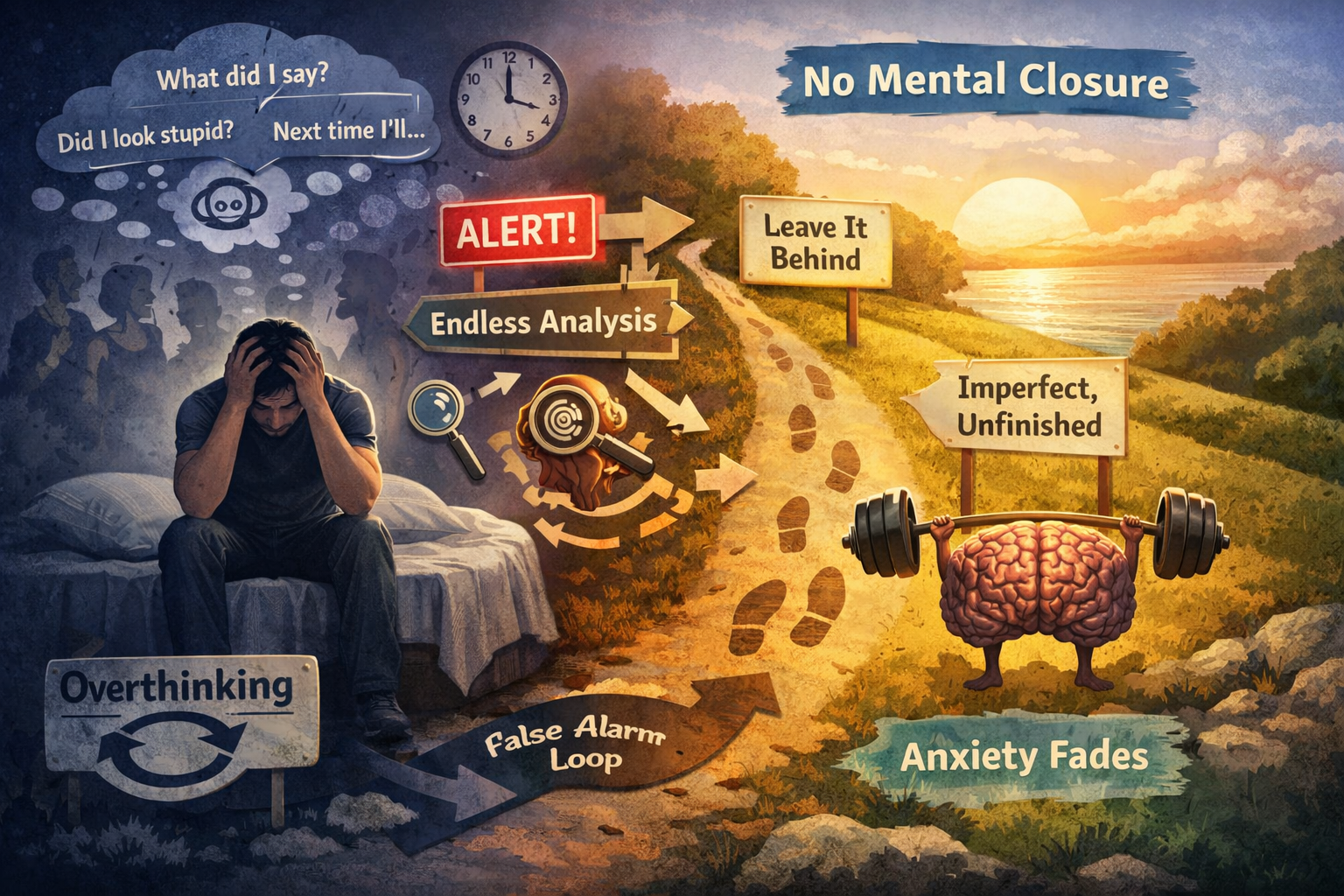

Anxiety disorders are marked by a persistent shift in attentional priorities: away from engagement with the external environment and toward relentless internal monitoring. This inward turn is not a sign of deeper insight or superior self‑regulation; instead, it reflects a maladaptive survival strategy organized by threat appraisal systems and supported by neurocognitive mechanisms that promote self‑focused attention, hypervigilance, and metacognitive monitoring. This article examines how anxiety reorganizes attention and experience, why constant self‑observation feels subjectively “responsible,” how different anxiety disorders consolidate this pattern, the neurological costs of observer mode, and why recovery fundamentally involves re‑engagement with lived experience rather than enhanced self‑control.
How Anxiety Shifts Attention from the External World to Internal Signals
Anxiety evolves from the activation of threat detection systems that prioritize cues predictive of danger. In healthy functioning, attention flexibly alternates between external stimuli relevant to goals and internal states that inform regulation (e.g., hunger). In anxiety disorders, this flexibility becomes biased toward internal signals.
The processes involved include:
- Self‑focused attention: Tendency to monitor thoughts, feelings, and somatic sensations with increased intensity. Rather than serving adaptive self‑reflection, this becomes chronic scanning for potential problems.
- Hypervigilance: Sustained elevation in sensitivity to threat‑related cues, whether external (perceived social evaluation) or internal (heart rate, tension, etc.).
- Interoceptive awareness: Heightened attention to bodily sensations (e.g., palpitations, respiration) that are misinterpreted as evidence of threat.
These mechanisms are not inherently pathological, but when threat appraisals become persistent and disproportionate to actual danger, attentional systems that evolved for short‑term survival remain engaged indefinitely.
Conceptual summary:
- Anxiety amplifies internal monitoring.
- Threat appraisal biases attention inward.
- Heightened interoception feeds back into worry and vigilance.
Why Constant Self‑Observation Feels Responsible and Intelligent but Reduces Presence and Spontaneity
At first glance, monitoring oneself might feel adaptive: it seems like careful self‑management, a responsible evaluation of one’s behavior and physiology. However, this impression is a cognitive veneer over a rigid, survival‑oriented allocation of attention.
Self‑monitoring in anxiety is characterized by:
- A sense of responsibility for preventing negative outcomes, which creates an illusion of control.
- A metacognitive belief that attention to internal processes yields useful information for managing risk.
- Reduced engagement with the external context because cognitive resources are preoccupied with internal states.
This pattern undermines presence and spontaneity:
- Divided attention: Cognitive capacity dedicated to monitoring cannot be fully engaged with the environment.
- Interruptions of flow: Moments that require unselfconscious action are disrupted by evaluative self‑checks.
- Reduced learning from experience: Instead of acting and then evaluating outcomes, anxious attention evaluates in advance, biasing experience toward avoidance.
Bullet points:
- Internal focus feels “intelligent” because it mimics self‑regulation.
- It reduces spontaneous engagement with the environment.
- It biases behavior toward safety at the cost of flexibility.
How Social Anxiety and Generalized Anxiety Reinforce This Pattern Differently
Although self‑focused attention is common across anxiety disorders, its targets and reinforcers vary by condition.
Social anxiety disorder (SAD):
- Threat appraisals are linked to evaluation by others.
- Individuals habitually monitor facial expressions, posture, speech fluency.
- The observer mode often manifests as watching oneself “from the outside” in imagined social scenarios.
Generalized anxiety disorder (GAD):
- Monitoring centers on potential future problems across domains.
- Attention shifts to internal dialog about risks, plans, and worst‑case outcomes.
- The metacognitive strategy is chronic worry, an attempt to anticipate and eliminate uncertainty.
Although different in content, both patterns share:
- Habitual fixation on internal cues.
- Overestimation of threat.
- Paradoxical reinforcement: brief relief from worry validates self‑monitoring.
The Neurological Cost of Living in Observer Mode Rather than Experiential Mode
Neuroscientific evidence supports a distinction between networks involved in self‑referential processing and those engaged in external task‑focused activity.
Key networks include:
- Default Mode Network (DMN): Associated with self‑referential thought, autobiographical memory, and internal narrative generation. Excessive DMN activity correlates with rumination and self‑focus.
- Task‑Positive Networks (e.g., Central Executive Network): Support goal‑directed attention and interaction with the environment.
In anxiety disorders:
- DMN may show increased baseline activity, reflecting persistent internal simulation and evaluation.
- Task‑positive networks may be under‑recruited, limiting effective engagement with external demands.
This imbalance has functional consequences:
- Cognitive resources are consumed by self‑monitoring.
- Working memory is biased toward threat content.
- Learning from actual environmental feedback diminishes.
Short conceptual summary:
- Anxiety biases network dynamics toward internal processing.
- This undermines experiential engagement and adaptive attention.
Why Recovery Involves Re‑engaging with Experience Rather than Improving Self‑Control
Traditional metaphors (e.g., “gain control over thoughts”) imply that anxiety is a failure of willpower. This misconstrues anxiety as a moral or character deficit. Instead, anxiety reflects a conditioned attentional bias maintained by avoidance and maladaptive appraisal.
Healthy self‑reflection differs from pathological self‑monitoring:
Healthy self‑reflection:
- Episodic and context‑sensitive.
- Informs learning after action.
- Integrates external feedback.
Pathological self‑monitoring:
- Persistent and automatic.
- Evaluative before, during, and after action.
- Driven by threat anticipation rather than feedback.
Recovery, therefore, involves:
- Rebalancing attention toward external and contextual information.
- Reducing threat appraisal biases that sustain inward focus.
- Developing flexibility in switching between internal and external attention.
The goal is not to eliminate internal awareness, but to ensure it is proportionate and purposeful.
Conclusion
Anxiety disorders cultivate a form of internal surveillance that masquerades as responsible self‑regulation while diminishing presence in the external world. This observer mode is sustained by cognitive and neural biases that privilege self‑focused attention and threat anticipation. Recovery centers on restoring the capacity to engage with life’s complexities rather than perfecting internal monitoring.
References
Barlow, D. H. (2002). Anxiety and Its Disorders: The Nature and Treatment of Anxiety and Panic. Guilford Press.
Clark, D. M., & Wells, A. (1995). A cognitive model of social phobia. In R. Heimberg et al. (Eds.), Social Phobia: Diagnosis, Assessment, and Treatment.
Rapee, R. M., & Heimberg, R. G. (1997). A cognitive‑behavioral model of anxiety in social phobia.
Wells, A. (2009). Metacognitive Therapy for Anxiety and Depression. Guilford Press.
Research on DMN and anxiety (e.g., Buckner, Andrews‑Hanna, & Schacter, 2008; Paulus & Stein, 2006)