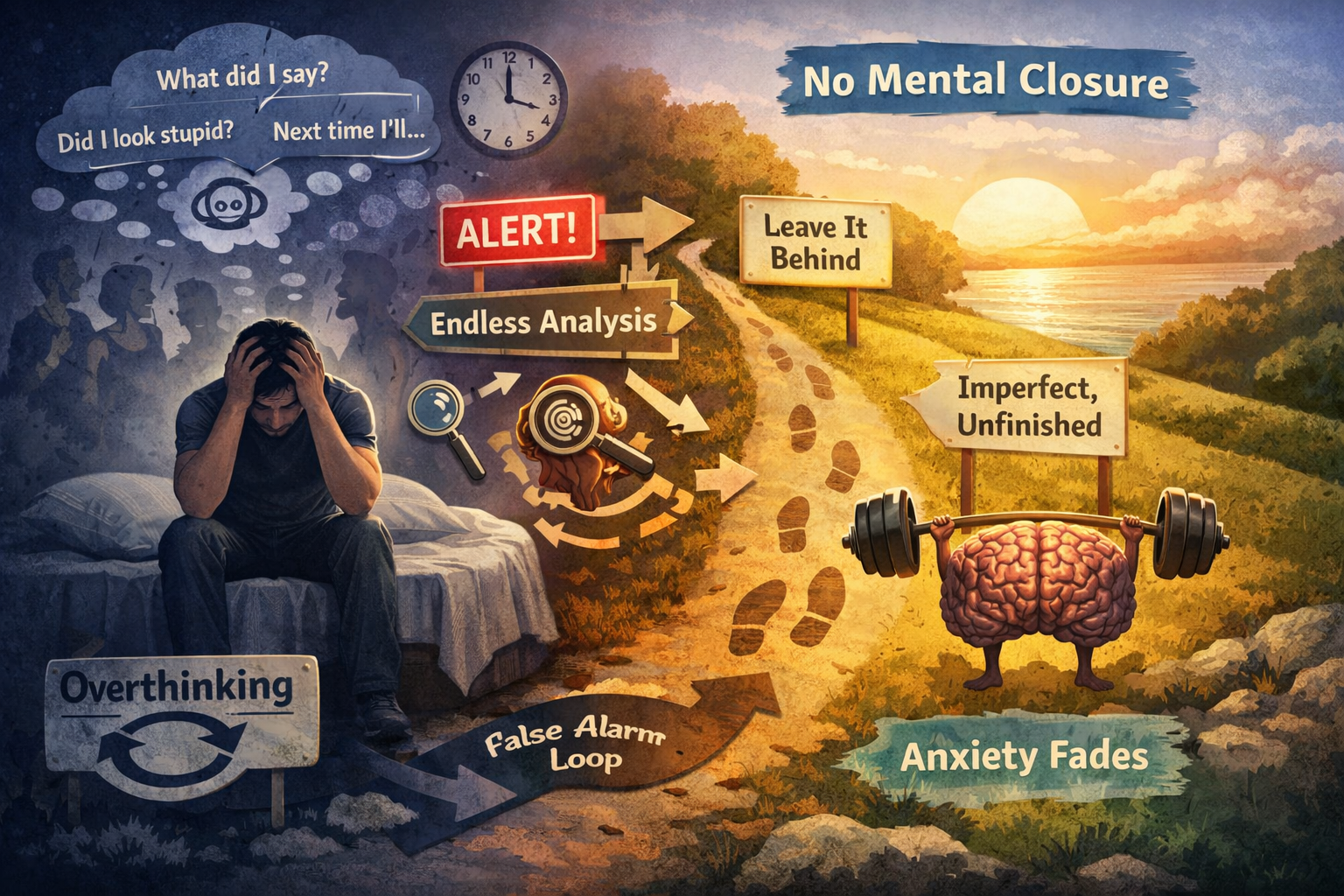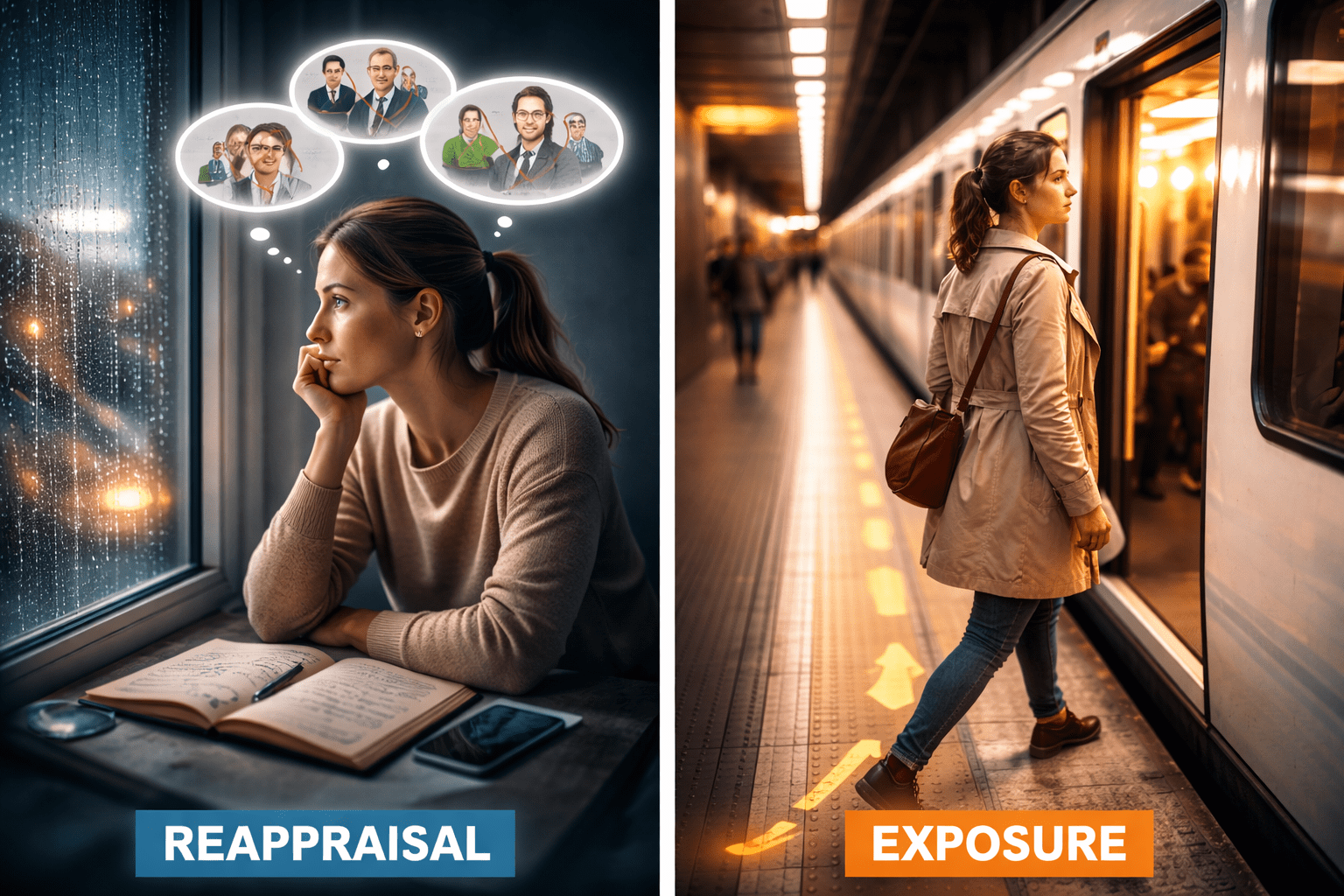

Anxiety disorders are not simply problems of “too much emotion.” They are disorders of threat prediction. Individuals with social anxiety, generalized anxiety disorder (GAD), panic disorder, or phobias consistently overestimate the likelihood and cost of danger. Cognitive Behavioral Therapy (CBT), pioneered by researchers such as Aaron T. Beck and later refined by Clark & Wells, Hofmann, and Craske, directly targets this predictive machinery.
Yet an important distinction often gets blurred: reducing predicted threat is not the same as updating fear memory. Cognitive reappraisal lowers expectancy. Exposure rewires learning. Effective CBT requires both.
Anxiety as Exaggerated Threat Prediction
At its core, anxiety reflects a forward-looking computation:
- How likely is something bad to happen?
- How bad would it be?
- Could I cope if it did?
In anxiety disorders, these estimates become systematically biased. Threat probability is inflated, consequences are catastrophized, and coping capacity is underestimated. This pattern drives avoidance, safety behaviors, and reassurance-seeking, behaviors maintained through negative reinforcement (temporary relief strengthens avoidance).
From a learning perspective, anxiety disorders are sustained by fear conditioning: neutral cues (e.g., eye contact, bodily sensations, uncertainty) become associated with threat. The amygdala encodes these associations rapidly and efficiently, preparing the organism for danger.
The problem is not that the system is broken. It is that it is overpredicting threat.
What Cognitive Reappraisal Actually Does
Cognitive reappraisal, central to Beck’s cognitive model and Clark & Wells’ social anxiety framework, works at the level of interpretation and expectancy.
Reappraisal helps patients:
- Identify distorted appraisals
- Generate alternative interpretations
- Recalculate threat probability
- Re-estimate coping ability
This reduces predicted threat. When expectancy decreases, distress decreases. Prefrontal cortical regions (especially dorsolateral and ventromedial PFC) exert regulatory influence over amygdala activation, a process often described as amygdala–prefrontal regulation.
Importantly, reappraisal improves:
- Emotional tolerance
- Behavioral willingness
- Meta-cognitive awareness
However, it primarily modifies conscious interpretation. It does not directly erase conditioned fear memory stored in subcortical circuits.
Lowering Distress Is Not the Same as Updating Fear Memory
A key clinical insight: someone can believe a situation is safe and still feel fear.
Why?
Because conditioned fear associations, encoded in amygdala-centered networks, remain intact even when cognitive appraisal changes. The individual’s expectancy shifts at a reflective level, but the associative learning persists.
This explains why patients often say:
“I know it’s irrational, but I still feel anxious.”
Reappraisal reduces predicted catastrophe. It does not automatically generate the learning signal necessary to update fear circuitry. That requires prediction error.
Exposure and the Power of Prediction Error
Exposure therapy creates a structured mismatch between expectation and outcome.
If a socially anxious person predicts humiliation and instead experiences neutral or mildly positive feedback, the brain registers a prediction error:
Expected threat ≠ actual outcome.
This mismatch drives new learning. According to Craske’s inhibitory learning model, exposure does not erase original fear memories. Instead, it builds new inhibitory associations that compete with threat predictions.
Mechanistically:
- The amygdala encodes threat associations.
- The ventromedial prefrontal cortex (vmPFC) encodes safety signals.
- The hippocampus contextualizes learning.
Repeated exposure strengthens inhibitory pathways, increasing the likelihood that safety learning overrides threat retrieval in future contexts.
This is qualitatively different from merely feeling calmer.
Fear Extinction and Inhibitory Learning
Research in fear extinction demonstrates:
- Fear memory is durable and resistant to erasure.
- Extinction involves new learning, not deletion.
- Context strongly influences retrieval.
Inhibitory learning models emphasize:
- Maximizing expectancy violation
- Reducing reliance on safety behaviors
- Varying contexts to promote generalization
- Tolerating distress rather than prematurely reducing it
Exposure works best when the goal is not “feeling less anxious,” but rather disconfirming feared predictions.
The Myth of “Just Change Your Thoughts”
A common misunderstanding is that anxiety persists because individuals have not tried hard enough to think rationally. This oversimplifies the neurobiology of fear.
Cognitive change without behavioral testing often results in:
- Intellectual insight without emotional shift
- Continued avoidance
- Fragile gains vulnerable to stress
Reappraisal is valuable. It:
- Reduces anticipatory distress
- Increases approach behavior
- Improves engagement in exposure
But without exposure-driven prediction error, fear networks remain largely unchanged.
Why Exposure Is Foundational in Social Anxiety and GAD
In social anxiety, core predictions revolve around humiliation, rejection, or visible anxiety symptoms. Only behavioral experiments, giving a presentation, initiating conversation, tolerating awkward pauses, generate the data necessary to update those predictions.
In GAD, the feared outcome is often uncertainty itself. Exposure to uncertainty (e.g., delaying reassurance, allowing unanswered questions) produces learning that worry is not protective and catastrophe does not reliably follow.
In both conditions:
- Avoidance maintains threat prediction.
- Reappraisal reduces expectancy.
- Exposure restructures fear learning.
Durable change depends on this restructuring.
Integrating Both Processes
The most effective CBT integrates:
- Cognitive reappraisal to recalibrate exaggerated threat prediction.
- Exposure to create prediction error and strengthen inhibitory learning.
Reappraisal prepares the ground. Exposure updates the circuitry.
Symptom relief (feeling calmer) and fear updating (altering associative learning) are related but distinct processes. A patient may experience reduced anxiety through cognitive means, but without exposure-based learning, the original fear network remains poised for reactivation.
CBT works best when both levels, interpretation and learning, are addressed deliberately and systematically.
Conclusion
Anxiety disorders are disorders of prediction. Cognitive reappraisal lowers predicted threat and improves regulatory control. Exposure produces prediction error and rewires threat learning through inhibitory mechanisms.
They are complementary, not interchangeable.
Reducing distress is valuable. Updating fear is transformative. Durable recovery requires both.