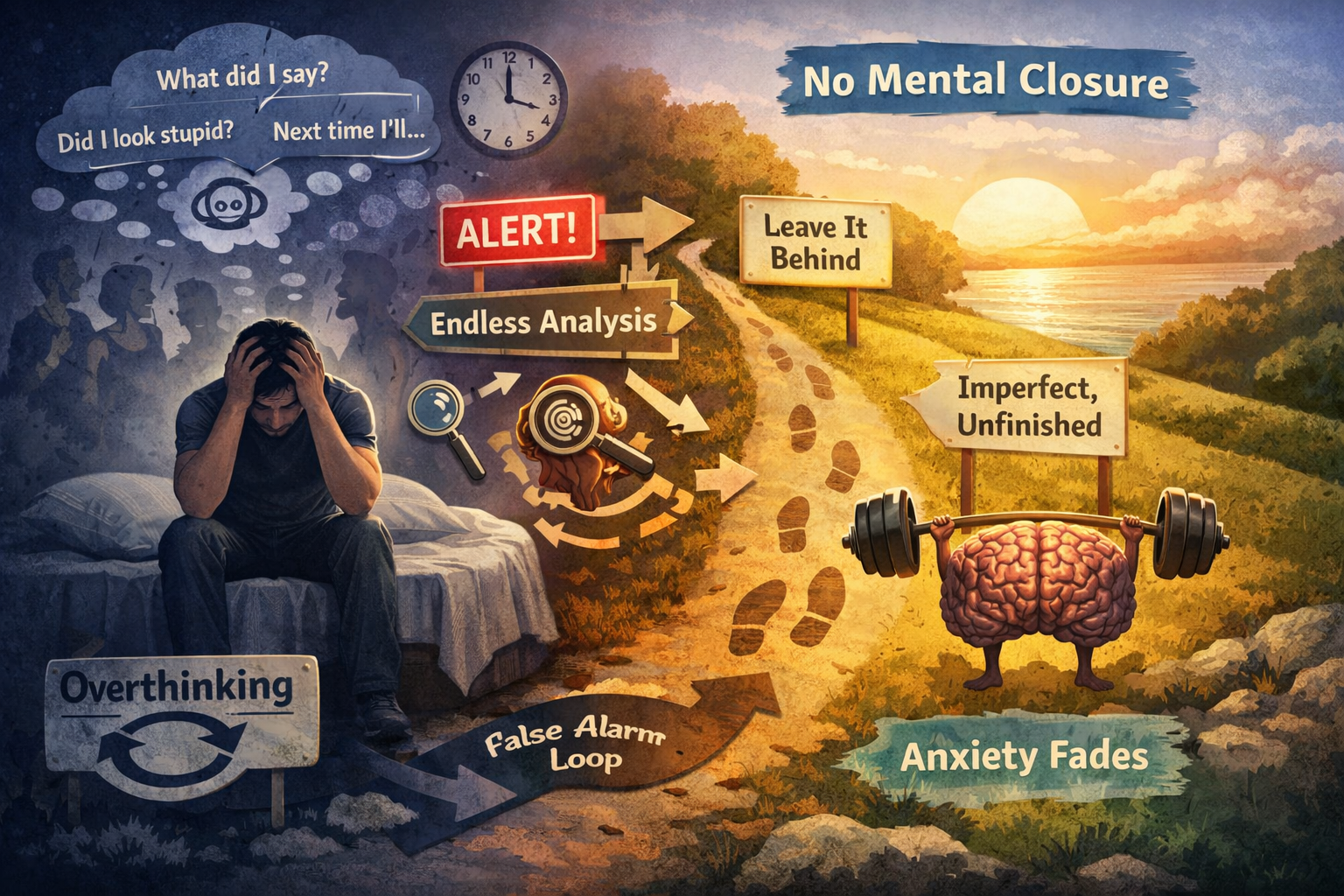

A CBT-Based Analysis
The core issue in social anxiety is not that other people form opinions. In any complex social system, evaluation is unavoidable. The difficulty lies in how the anxious brain assigns excessive weight to those opinions, inflating their probability, permanence, and consequences.
Cognitive Behavioral Therapy (CBT) conceptualizes social anxiety as a pattern of distorted threat appraisal rather than a deficit in competence or intelligence. High-functioning individuals often understand social dynamics well; the distortion occurs in the perceived cost of negative evaluation.
The Cognitive Model: Inflated Probability and Cost
CBT research shows two consistent biases:
- Overestimation of likelihood: “They will think I’m incompetent.”
- Overestimation of cost: “If they think that, my reputation will suffer significantly.”
The anxious prediction chain often proceeds:
Minor social ambiguity → Assumed negative judgment → Catastrophic downstream consequences → Global self-evaluation.
In most real-world contexts, however, social judgments are partial, temporary, and low-impact.
Core Cognitive Distortions
1. Mind Reading
Assuming knowledge of others’ internal evaluations without sufficient evidence.
Example: In a meeting, a colleague looks distracted.
Interpretation: “They think I’m unclear.”
Ignored alternatives: fatigue, unrelated concerns, multitasking.
2. Catastrophizing
Projecting small missteps into enduring damage.
Example: Momentary hesitation while speaking → “I’ve undermined my credibility.”
3. Overestimation of Negative Evaluation
Believing that others are constantly monitoring and critically evaluating one’s performance. This overlaps with the “spotlight effect,” where personal salience is exaggerated.
4. External Validation Dependence
Equating approval with personal worth. This is not the same as valuing feedback; it is treating external evaluation as the primary determinant of self-assessment.
Evolutionary Roots of Social Threat Sensitivity
Human threat systems evolved in small tribal groups where social exclusion could reduce survival odds. Sensitivity to status and belonging was adaptive.
Modern contexts, corporate meetings, large social networks, online platforms, activate the same neural circuitry. The brain often interprets mild reputational risk as existential threat. Social anxiety reflects a lowered threshold for triggering this system and an inflated forecast of consequences.
What CBT Actually Teaches
CBT does not encourage ignoring others’ opinions. Social evaluation carries information. Professional feedback matters. Reputation influences opportunity.
The therapeutic aim is recalibration, adjusting the perceived weight of social evaluation to align more closely with realistic impact.
Instead of:
“They might judge me, therefore this is dangerous.”
It becomes:
“They might judge me. The consequences are likely limited and manageable.”
Practical CBT Techniques
Cognitive Restructuring
Automatic thought (work meeting):
“If I ask this question, they’ll think I’m unprepared.”
Evidence for: I don’t fully understand the topic.
Evidence against: Others ask questions; clarification often signals engagement; no history of ridicule.
Balanced conclusion: The probability of severe negative judgment is low; even if it occurs, the impact is likely modest.
The goal is probabilistic correction, not forced optimism.
Behavioral Experiments
Predictions are tested empirically.
Social gathering prediction:
“If I pause awkwardly, the conversation will collapse.”
Experiment: Allow a brief pause.
Outcome: Others contribute; interaction continues.
Repeated testing weakens catastrophic forecasts by replacing imagined outcomes with observed data.
Exposure Logic
Avoidance preserves distorted beliefs by preventing disconfirmation.
Online example:
Prediction: “If I post an opinion, I’ll receive harsh criticism.”
Exposure: Post a measured viewpoint.
Observed result: Neutral or limited engagement; manageable disagreement.
Exposure demonstrates that negative evaluation, when it occurs, is often tolerable and transient.
Real-World Applications
Work Meetings
Shift focus from impression management to contribution.
Behavioral target: Offer one concise point rather than monitoring perceived reactions continuously.
Social Gatherings
Replace “I must be interesting” with “I will engage with curiosity.”
Measure outcomes rather than relying on internal anxiety as evidence.
Posting Online
Estimate realistic impact:
How many people will actually see this?
How long will they remember it?
What is the plausible worst-case scenario?
Practical Takeaways
- Distinguish possibility from probability.
- Separate discomfort from disaster.
- Test predictions behaviorally.
- Evaluate duration and scope of potential judgment.
- Reduce avoidance incrementally to gather corrective evidence.
Social anxiety is not a failure of rationality or intelligence. It is a miscalibration of social threat weighting. CBT does not remove concern for others’ opinions. It reduces the exaggerated authority those opinions are assumed to carry.