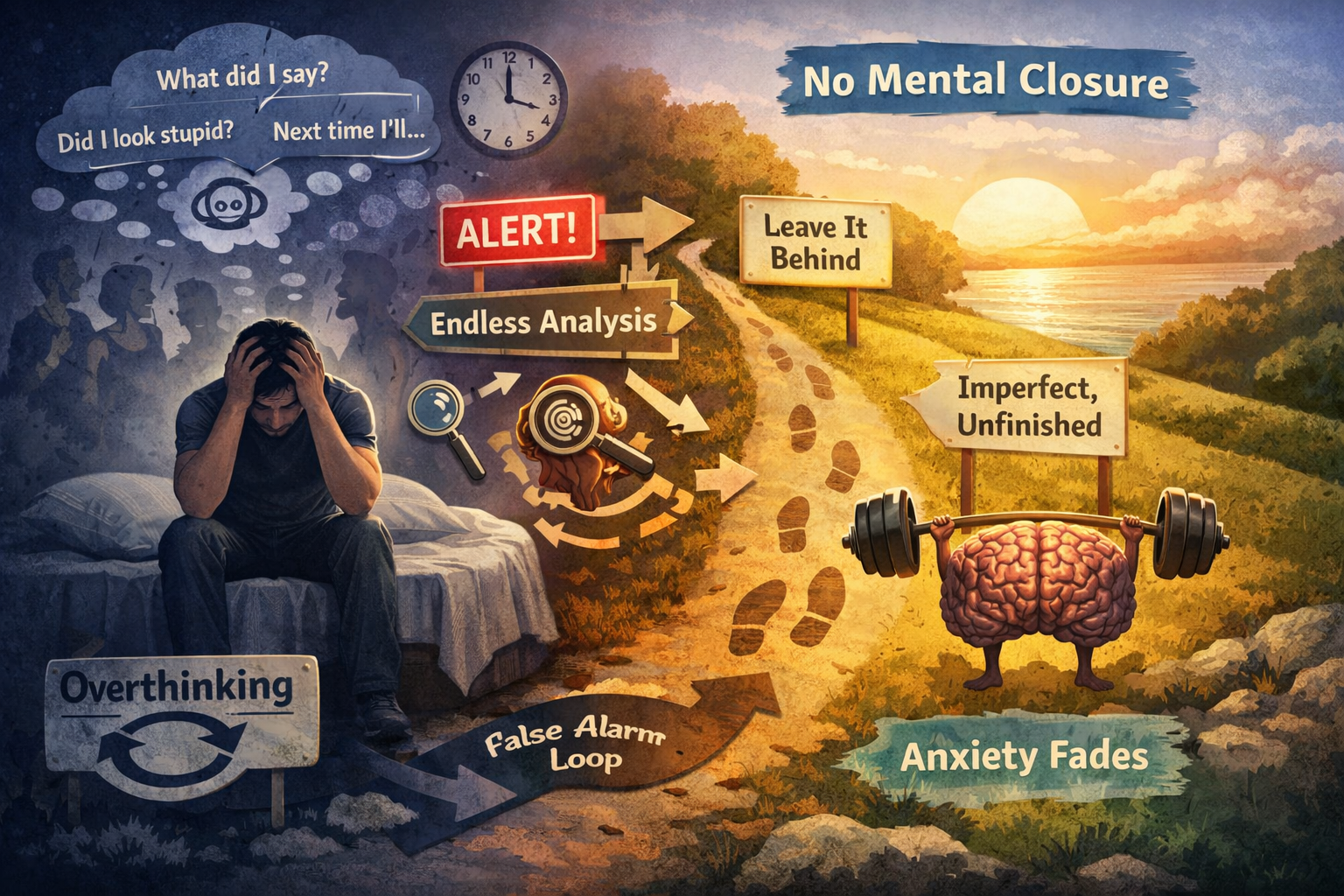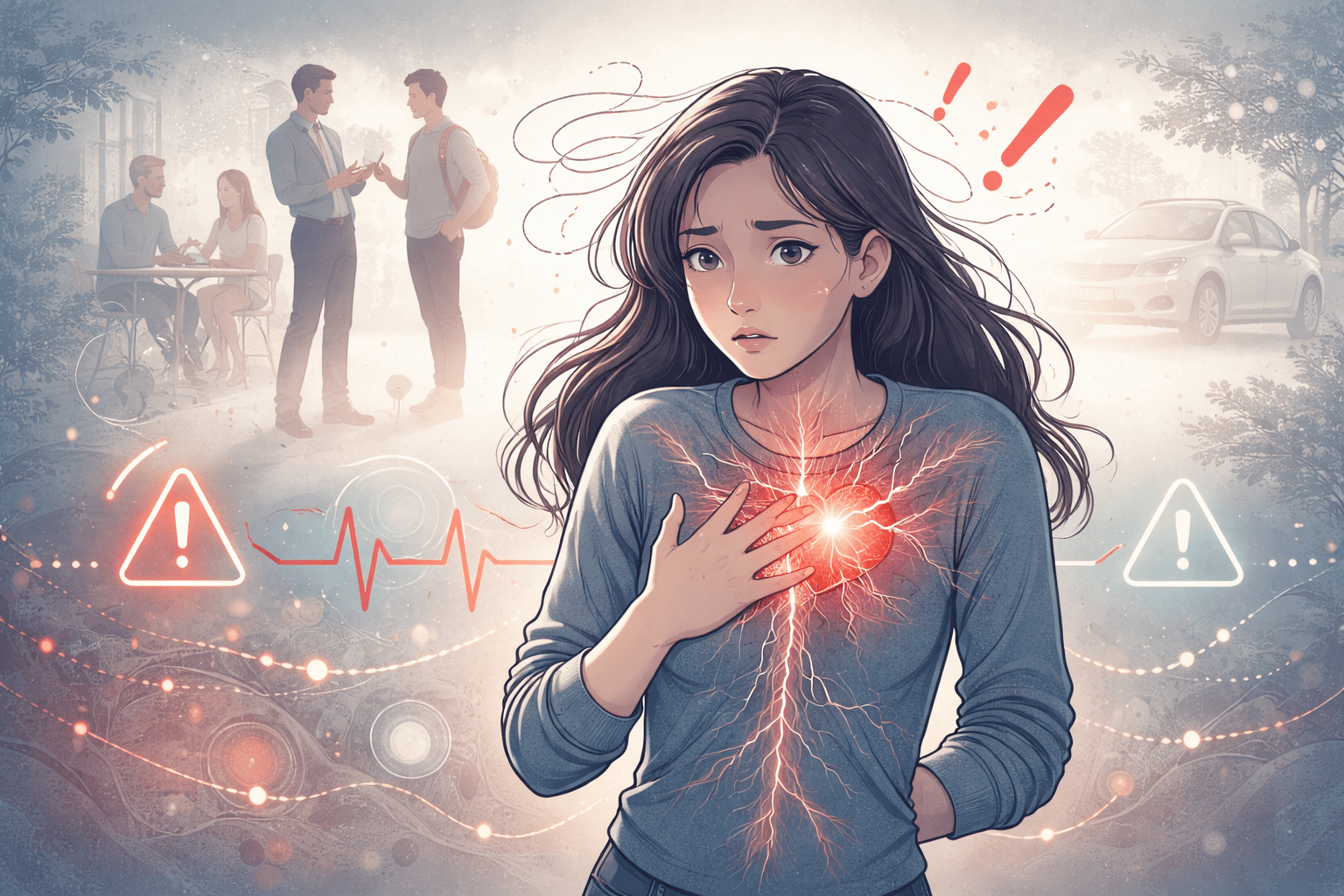

Many individuals with generalized anxiety disorder (GAD) and social anxiety disorder (SAD) describe a perplexing experience: they intellectually recognize that a situation carries minimal real-world consequences, yet their emotional and physiological reaction is intense and difficult to control. A brief email from a supervisor, a delayed text reply, or a minor social interaction can trigger marked autonomic arousal, racing heart, muscle tension, gastrointestinal discomfort, despite objectively neutral circumstances.
This phenomenon is not a failure of logic or character. It reflects learned neural associations, altered threat prediction, and sensitized autonomic responding.
The Core Mismatch: External Impact vs. Internal Response
A crucial distinction must be made between:
- Actual external consequences (what realistically happens)
- Internal conditioned responses (what the nervous system predicts will happen)
In GAD and SAD, the nervous system reacts to predicted threat, not verified outcome. The amygdala-centered threat detection network, described extensively by Joseph LeDoux in research on fear conditioning, responds to cues that have acquired threat value through prior learning. Once a stimulus has been associated with humiliation, rejection, uncertainty, or stress, it can activate autonomic defense systems even when conscious appraisal recognizes no real danger.
This is why insight alone does not deactivate the reaction: the defensive response is initiated subcortically before reflective cognition fully engages.
How the Threat System Becomes Over-Trained
1. Conditioned Threat Learning
Through classical conditioning, neutral stimuli become linked with aversive emotional states:
- Social embarrassment → public speaking cues become threat signals
- Chronic criticism → authority figures acquire threat value
- Repeated worry rehearsal → imagined scenarios become emotionally encoded
The amygdala strengthens synaptic connections between cues and defensive outputs. Over time, this produces rapid autonomic activation in response to minimal triggers.
2. Nervous System Sensitization
Chronic stress and sustained worry increase baseline arousal. Repeated activation lowers the threshold for future activation:
- Heightened sympathetic tone
- Increased interoceptive sensitivity
- Faster amygdala firing
- Reduced prefrontal inhibitory regulation
The system becomes biased toward detection of potential danger, even in ambiguous contexts.
3. Predictive Processing Errors
Contemporary neuroscience conceptualizes the brain as a predictive organ. It continuously generates models about what will happen next. In GAD and SAD, these predictions are skewed toward threat expectancy:
- Overestimation of negative outcomes
- Underestimation of coping ability
- Intolerance of uncertainty
- Heightened perception of social status threat
Because prediction precedes perception, the body mobilizes before evidence is evaluated.
Why the Nervous System Reacts Faster Than Cognition
Defensive circuits operate through rapid thalamo-amygdala pathways. Cortical appraisal systems, particularly medial and dorsolateral prefrontal regions, require more processing time. By the time conscious reasoning evaluates the situation, sympathetic activation is already underway.
This temporal gap explains why individuals may think, “This is irrational,” while simultaneously experiencing intense physiological arousal.
Maintenance Mechanisms in GAD and SAD
Generalized Anxiety Disorder (Borkovec’s model of worry)
- Persistent future-oriented threat simulation
- Worry used as cognitive avoidance of emotional imagery
- Negative reinforcement: worry temporarily reduces uncertainty, reinforcing the cycle
- Continuous rehearsal strengthens threat networks
The future becomes encoded as chronically dangerous.
Social Anxiety Disorder (Clark & Wells model)
- Heightened self-focused attention
- Biased interpretation of ambiguous social cues
- Status and evaluation sensitivity
- Post-event rumination strengthening memory of perceived failure
Social contexts become conditioned predictors of humiliation, even when outcomes are neutral.
Why Insight Is Not Sufficient
Intellectual awareness engages cortical systems. Conditioned fear responses are stored in subcortical circuits. These memory traces are durable and not erased by reasoning. Treatment does not “delete” fear associations; instead, it builds competing inhibitory memories.
Michelle Craske’s inhibitory learning model emphasizes that exposure therapy works by:
- Violating threat expectations
- Building new non-threat associations
- Increasing tolerance of uncertainty
- Enhancing inhibitory control over amygdala output
Recalibration requires experiential learning, not solely cognitive understanding.
A More Realistic Marker of Recovery
The goal is not elimination of emotion. Anxiety is a functional survival system. A more clinically meaningful marker of progress is:
- Reduced duration of autonomic activation
- Faster return to baseline
- Decreased avoidance
- Increased behavioral flexibility
The reaction may still occur, but it resolves more quickly and exerts less behavioral control.
Reframing Disproportionate Anxiety
Disproportionate reactions in GAD and SAD are not signs of fragility. They reflect:
- Conditioned neural associations
- Sensitized autonomic circuits
- Biased predictive models
- Reinforced avoidance learning
Research in fear conditioning, autonomic reactivity, and threat learning consistently demonstrates that repeated experience shapes neural response thresholds. The nervous system learns from past exposure, especially social humiliation, chronic stress, or persistent worry rehearsal, and generalizes forward.
Treatment aims to recalibrate these systems through exposure, corrective emotional experience, and inhibitory learning. The objective is not intellectual certainty but embodied safety learning.
Disproportionate reactions are learned patterns within adaptive survival circuitry. They can be reshaped through systematic, experience-based intervention.