
An Evidence‑Based Perspective on Anxiety, Coping Strategies, and Cognitive Behavioral Science
Introduction: Why This Argument Is Counterintuitive
In contemporary discourse, “positive thinking” is often proposed as a universal solution for distress. Yet, within clinical psychology, especially in the context of anxiety disorders, forced or excessive positive thinking can paradoxically maintain or intensify distress. This article examines how this occurs, drawing on well‑established psychological concepts such as experiential avoidance, emotional suppression, toxic positivity, ironic process theory, metacognitive beliefs, intolerance of uncertainty, and empirically supported cognitive‑behavioral frameworks. The aim is to clarify why rigid positivity is not only ineffective but potentially maladaptive in anxiety disorders.
How Positive Thinking Evolved as a Coping Idea and Why It Is Appealing
The notion of positive thinking has deep roots in Western self‑help and popular psychology, emphasizing optimism as a buffer against stress and adversity. This idea aligns with everyday intuitions: feeling hopeful feels better than feeling anxious. Popular culture often equates positivity with resilience, encouraging individuals to supplant “negative” thoughts with “positive” ones. However, such framing neglects key psychological mechanisms that govern cognitive and emotional regulation. Importantly, the widespread appeal of positive reframing conflates adaptive cognitive reappraisal with efforts to suppress or override distressing experiences, a distinction that has profound clinical implications.
When and Why Positive Thinking Backfires in Anxiety Disorders
In anxiety disorders, efforts to force positive thinking frequently function as experiential avoidance, a process where individuals strive to suppress, change, or control unwanted internal experiences rather than engage with them. Experiential avoidance is implicated in maintaining psychopathology because it reinforces avoidance of discomfort, thereby preventing habituation and adaptive coping.
Toxic positivity, a related social construct, refers to the cultural imperative to remain upbeat and to dismiss or invalidate negative feelings. Although not a clinical term, it encapsulates the pressure individuals feel to deny distressing emotions, which can elicit secondary emotions like shame, guilt, or increased anxiety when negativity persists despite efforts to suppress it.
According to ironic process theory (Wegner), intentional suppression of thoughts increases their frequency and accessibility. In experimental settings, attempts to avoid thinking of a specific content (e.g., a white bear) led to paradoxically more frequent thoughts about it, especially under cognitive load.
Thus, in the context of anxiety, rigid positive thinking often isn’t just unhelpful, it may heighten monitoring of feared content, reinforce avoidance motivations, and contribute to the very distress individuals seek to reduce.
Flexible Cognitive Reappraisal vs. Rigid Positivity
A critical distinction exists between cognitive reappraisal (a flexible reframing strategy supported by emotion regulation research) and rigid positivity or suppression. Adaptive reappraisal involves contextually appropriate reinterpretation of a thought without invalidating the emotional experience itself, whereas rigid positivity typically entails trying to replace or eliminate anxiety‑related thoughts and feelings.
Rigid positivity increases cognitive load and prioritizes thought control, which paradoxically enhances attention to the suppressed content (a process described by ironic rebound effects). By contrast, flexible reappraisal acknowledges negative affective information and then integrates it into a broader, realistic appraisal, reducing emotional distress without suppressing its presence.
How Forcing Positive Thoughts Increases Monitoring, Self‑Criticism, and Rumination
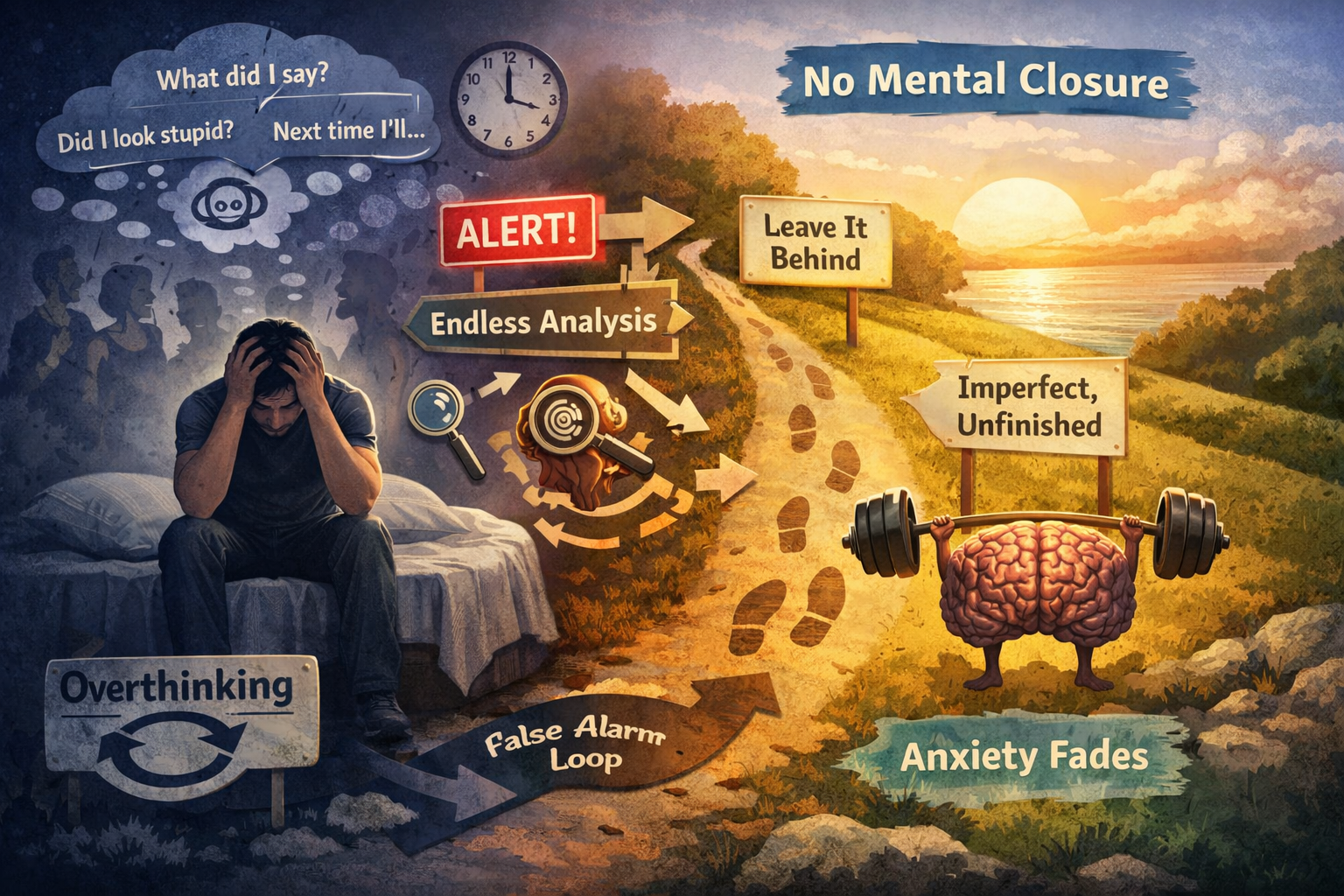
When individuals attempt to suppress or override anxiety‑related thoughts, cognitive control resources focus not only on those thoughts but also on the fact that they remain present, fostering heightened threat monitoring. Excessive monitoring of internal experiences predicts greater rumination and self‑criticism: individuals judge themselves as “failing” to maintain positivity, which further amplifies distress. This cycle reflects a shift from adaptive processing toward maladaptive metacognitive beliefs (e.g., “I must not think anxious thoughts”) that sustain worry and negative affect.
Aversive reactivity constructs like experiential avoidance, intolerance of uncertainty, and distress intolerance correlate with increased maladaptive coping behaviors and are central transdiagnostic features in anxiety disorders. Short‑term avoidance may feel relieving, but long‑term avoidance and suppression practices reinforce anxiety rather than ameliorate it.
What CBT Research Shows: Acceptance and Exposure vs. Thought Replacement
Cognitive Behavioral Therapy (CBT) is an evidence‑based treatment with robust support across anxiety disorders and related conditions. Meta‑analyses indicate consistent superiority of CBT for anxiety symptoms relative to comparison conditions.
Traditional CBT includes techniques such as cognitive restructuring, behavioral experiments, and exposure to feared stimuli rather than simple substitution of positive thoughts. In contrast, strategies that center on thought supression or overly simplified positivity are typically not central to CBT precisely because of their limited efficacy and potential for paradoxical effects.
Third‑wave CBT modalities (e.g., Acceptance and Commitment Therapy) emphasize reducing experiential avoidance and increasing psychological flexibility through acceptance and mindfulness strategies. Empirical research supports that reductions in experiential avoidance correlate with improvements in anxiety symptoms, and acceptance‑based approaches can be effective for social anxiety and generalized anxiety symptoms when compared to or integrated with traditional CBT techniques.
These frameworks encourage contact with internal experiences rather than their suppression, a key therapeutic shift away from rigid positivity toward adaptive engagement with distress.
Real‑World Implications for Social Anxiety and Generalized Anxiety
For individuals with social anxiety disorder (SAD), fear of negative evaluation and discomfort in social settings often drive avoidance behaviors. Forcing positive thoughts about social performance may inadvertently intensify self‑monitoring and increase subjective anxiety to perceived threat cues. In contrast, treatments that emphasize exposure and acceptance help individuals tolerate discomfort without amplifying self‑criticism.
In generalized anxiety disorder (GAD), intolerance of uncertainty is a core feature. Attempts to impose certainty via overly positive thinking may emphasize an unrealistic belief that worry can be fully controlled. Evidence shows that addressing intolerance of uncertainty through cognitive and behavioral strategies produces significant reductions in worry and associated symptoms.
Conclusion: Psychological Health Is About Flexibility, Not Constant Optimism
In summary, while positive thinking has intuitive appeal and can be valuable when applied flexibly within a broader regulatory context, rigid or forced positivity functions as a form of experiential avoidance that can sustain or exacerbate anxiety. A scientific understanding of cognition and emotion shows that acceptance, flexibility, and adaptive engagement with discomfort are more reliable correlates of psychological health than constant optimism or avoidance of negative states.
References
- Wegner DM, Schneider DJ, Carter SR, White TL. Paradoxical effects of thought suppression; ironic processes in mental control. Journal of Personality and Social Psychology.
- Hayes SC, Wilson KG, Gifford EV, Follette VM, Strosahl KD. Experiential avoidance and behavioral disorders: a functional dimensional approach. Journal of Consulting and Clinical Psychology.
- Hofmann SG, Asnaani A, Vonk IJ, Sawyer AT, Fang A. The efficacy of cognitive behavioral therapy: A review of meta‑analyses. Clinical Psychology Review.
- Wilson EJ, Abbott MJ, Norton AJ. The impact of psychological treatment on intolerance of uncertainty in generalized anxiety disorder: a meta‑analysis. Journal of Anxiety Disorders.
- Borkovec TD, Roemer L. Avoidance theory of worry and generalized anxiety disorder: basic mechanisms and treatment implications. In: Generalized Anxiety Disorder: Advances in Research and Practice. Guilford Press.