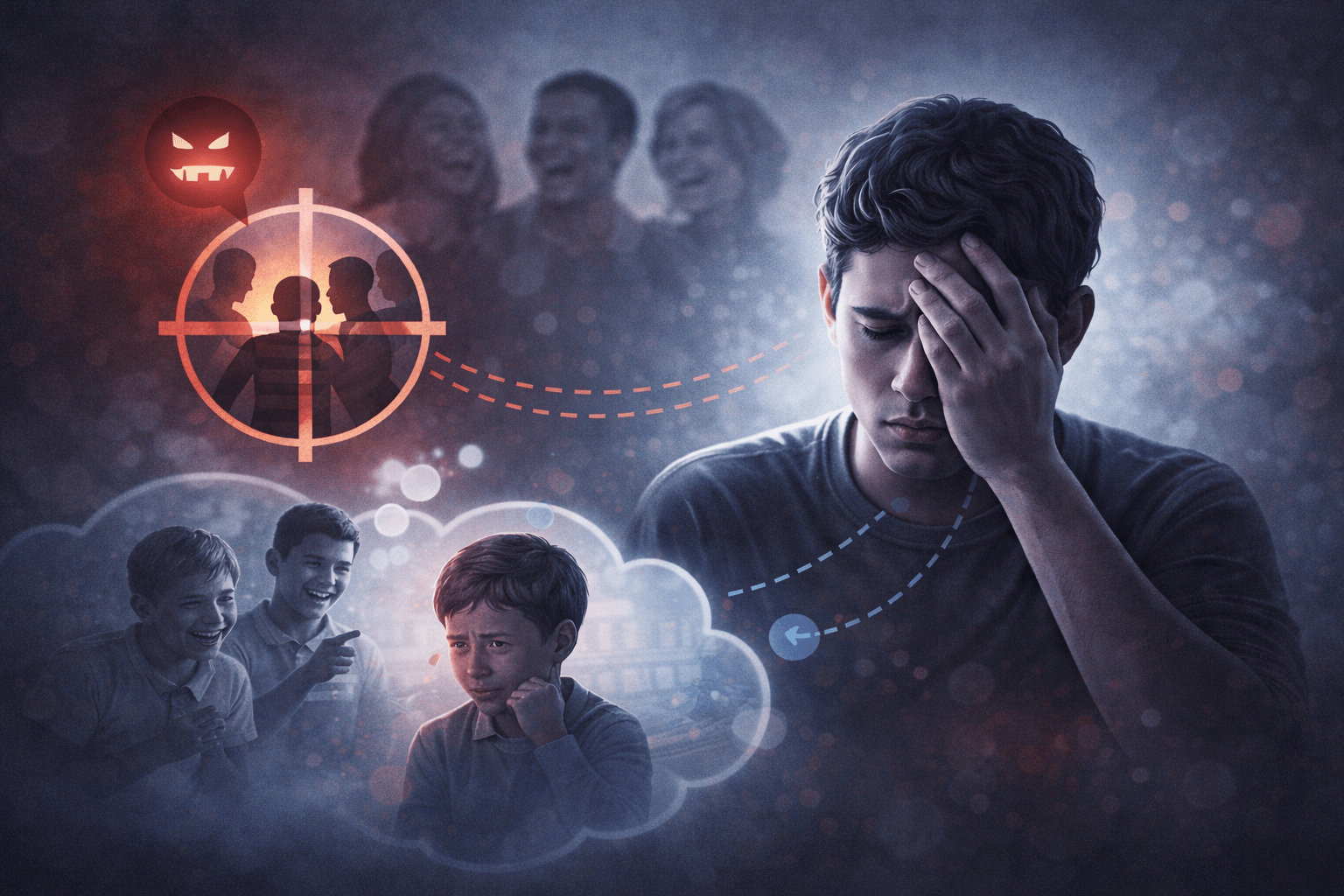

Laughter is usually benign social information, affiliation, play, tension release. Yet for many people with social anxiety, laughter in the background (especially when it’s ambiguous) can land as a jolt of danger. The reaction often feels immediate and bodily: a spike of heat, a tight throat, an urgent need to scan faces and “figure out” what just happened.
A useful way to conceptualize this is not “they’re laughing at me” as a deliberate conclusion, but as a rapid threat perception process: laughter is interpreted as a social status threat, which recruits shame networks, and may be amplified by emotional memory traces from earlier experiences of ridicule, exclusion, or being singled out. The result can be a disproportionately intense reaction to a stimulus that, on the surface, seems minor.
1) The evolutionary psychology of social status threat
Humans are intensely social and status-sensitive. Across our evolutionary history, access to protection, resources, mates, and coalition support depended in part on maintaining social inclusion and a tolerable rank position. Threats to status, being mocked, exposed, devalued, or pushed down, were not “just feelings.” They had consequences.
From this perspective, laughter is not only “sound.” It can function as a social signal that the brain treats as potentially rank-relevant:
- It can indicate ingroup bonding (laughing together).
- It can signal norm enforcement (laughing at a violation).
- It can mark dominance/submission dynamics (who is laughed at vs. who laughs).
- It can communicate exclusion (“we” share a joke; “you” don’t).
Paul Gilbert’s work in social rank theory emphasizes that shame and anxiety often track perceived social attractiveness and rank, how safe it feels to be seen, evaluated, and compared. In that frame, laughter becomes one of many cues that may be read through a rank lens rather than a neutral one. (BPS Psychology Hub)
Key implication: If your nervous system is tuned toward rank threats, ambiguous laughter can be processed as “danger to my standing,” not merely “someone found something funny.”
2) How the anxious brain over-detects social danger signals
Social anxiety is not simply “fear of people.” It is more precisely a heightened sensitivity to negative evaluation and its implications (rejection, humiliation, loss of status). Within that framework, the brain can develop a threat bias: an information-processing tilt toward detecting danger in social cues, particularly ambiguous ones.
Common features of this bias include:
- Ambiguity intolerance: unclear laughter defaults to “about me” or “bad for me.”
- Selective attention: rapid scanning for confirming cues (glances, smirks, whispering).
- Interpretation bias: assigning threatening meanings to neutral stimuli.
- Cost inflation: “If they’re laughing, I’ll be exposed; if exposed, I’ll be rejected.”
This isn’t irrational in the sense of being random. It’s a coherent system designed to minimize social harm by reducing uncertainty. The problem is calibration: when the detection threshold is too low, the system produces frequent false alarms.
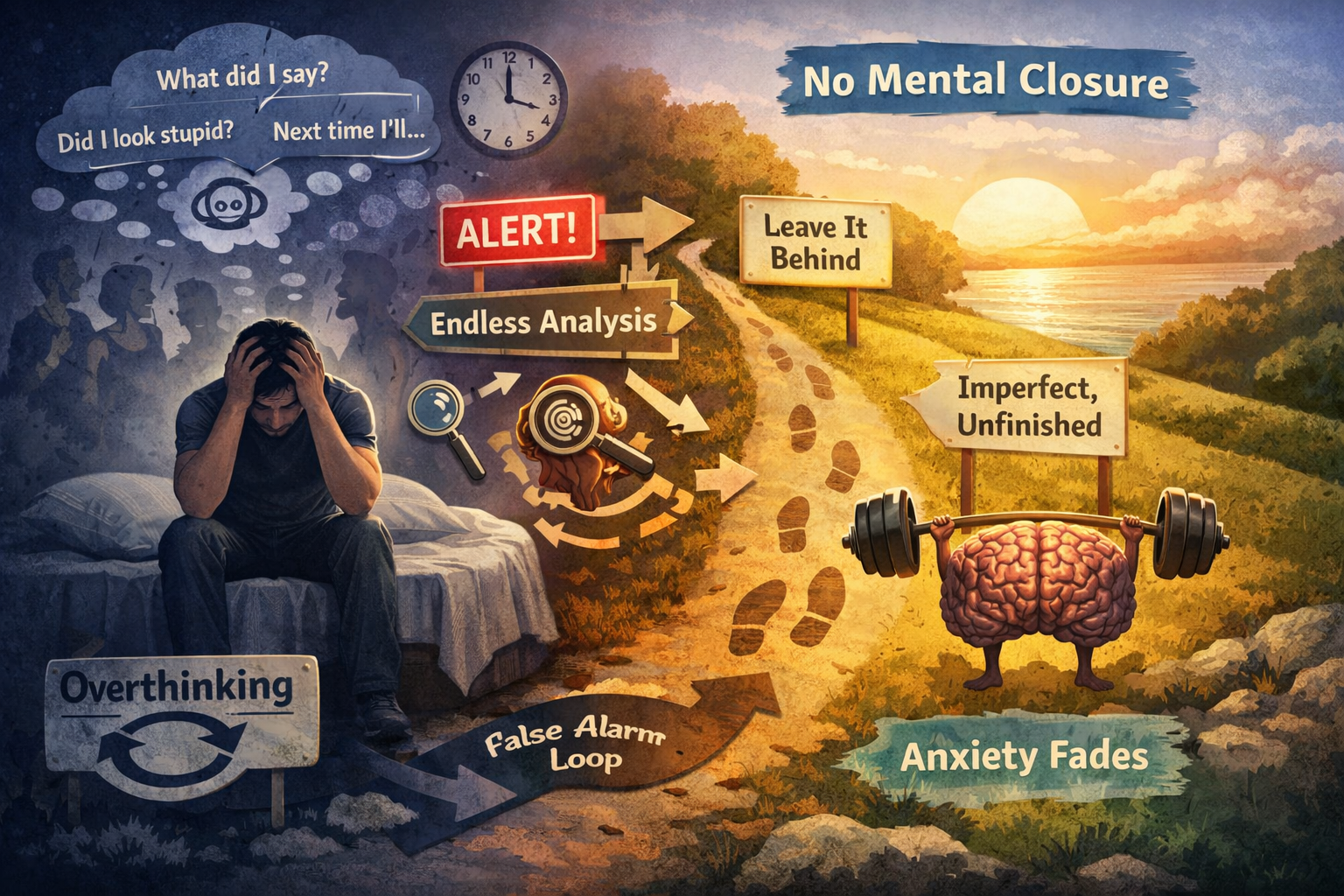
In many cognitive models of social anxiety, once threat is detected the person’s attention shifts inward (monitoring blush, voice, posture), and outward (monitoring others’ reactions), creating a self-reinforcing loop that keeps threat salient and makes disconfirmation harder. Clark & Wells’ model is one of the best-known formulations of this maintenance cycle. (PMC)
3) The neuroscience of shame and amygdala activation
When laughter is appraised as status-threatening, the body often responds as if to danger. A core node in rapid threat detection is the amygdala, which helps coordinate physiological and behavioral responses when something is tagged as significant, uncertain, or potentially harmful. Joseph LeDoux’s work distinguishes between threat processing systems (fast detection/response) and the later, more elaborated experience people label as “fear.” (Royal Society Publishing)
In social anxiety, the “threat” is often social rather than physical, but the body’s response repertoire overlaps: arousal, scanning, freezing, escape urges, and narrowed attention.
Shame as a threat-relevant emotion
Shame is not merely “feeling bad.” It is a self-conscious emotion tightly linked to social evaluation and rank. In threat terms, shame signals: “I may be seen as inferior, defective, or unacceptable, this could endanger belonging.” Gilbert’s research connects shame with social rank perceptions and the anticipation that others will devalue or derogate the self. (Wiley Online Library)
When shame networks activate, several things tend to happen simultaneously:
- Self-focused attention increases (“How do I look? What did I do?”).
- Mental imagery intensifies (flashbulb scenes of being judged).
- Action tendencies emerge (hide, shrink, appease, escape).
- Meaning-making narrows (threat-confirming interpretations dominate).
This is why laughter can feel “socially dangerous.” It is processed not just as an external sound but as a possible signal of devaluation, which the brain treats as consequential.
4) Early experiences, emotional conditioning, and “echoes” in the present
Many people can recall a time when laughter genuinely was a weapon: classmates snickering, a group joke at one’s expense, an embarrassing moment that became a story. Experiences like these can create durable learning through emotional conditioning.
Emotional conditioning in plain terms
If laughter (or certain contexts where laughter occurs) repeatedly coincided with humiliation, the brain can learn an association:
- Cue: laughter, whispering, a certain tone, a glance
- Meaning: “I’m being targeted / I’m unsafe socially”
- Response: arousal + shame + escape/avoidance
Over time, the cue can trigger the response even when the original meaning is not actually present. This is a conditioned response: automatic, fast, and often difficult to override in the moment.
Emotional memory and reconsolidation
Emotional memories are not stored like neutral facts. They are linked to body states, threat tags, and meaning structures. When a similar cue appears later, the memory can be reactivated, bringing “old emotion” into a new context. This is often experienced as an “echo”: the present moment feels heavier than it logically should because the nervous system is responding to more than the present.
Modern research on memory reconsolidation suggests that when emotional memories are reactivated, they can become temporarily malleable before being stored again. In clinical science, this idea helps explain why certain experiences can update old fear/shame learning, though “updating” is not automatic and typically requires specific learning conditions, not mere exposure to triggers. (Mechanism, not instruction.)
Why childhood and adolescence matter
Early social environments are high-stakes learning laboratories. Peer status, belonging, and reputation become central, and ridicule can be particularly potent because it targets identity. Those periods also tend to feature intense social comparison, making shame-based learning especially sticky.
5) How CBT conceptualizes these reactions
CBT doesn’t treat the reaction as mysterious. It models it as a predictable interaction between interpretations, beliefs, attention, and behavior, especially when threat and shame are involved.
In a CBT lens, laughter-trigger episodes often involve:
Automatic thoughts (fast interpretations)
- “They’re laughing at me.”
- “I look stupid.”
- “They’ve noticed something wrong.”
- “I’m about to be exposed.”
These thoughts are less like deliberate judgments and more like threat appraisals that arrive with bodily urgency.
Core beliefs and schema activation
Beneath automatic thoughts are broader meanings, schemas, that get activated by social cues:
- “I’m defective / unlikeable.”
- “If people see the real me, they’ll reject me.”
- “My status is fragile; one mistake will ruin me.”
When a schema activates, perception becomes biased toward evidence that fits it (threat bias), and contradictory information is discounted.
Safety behaviors and negative reinforcement
To manage perceived threat, people often use safety behaviors, subtle strategies intended to prevent rejection or humiliation:
- avoiding eye contact
- rehearsing sentences mentally
- speaking less or “playing small”
- checking others’ facial expressions repeatedly
- leaving early, staying near exits
- masking anxiety symptoms at all costs
These behaviors reduce distress short-term, which makes them more likely to repeat, a classic negative reinforcement loop. But they can also maintain anxiety by preventing the person from learning that the feared outcome is less likely than predicted, or that they can tolerate uncertainty. Clark & Wells’ model and later reviews describe how these processes sustain social anxiety over time. (PMC)
6) How exposure and cognitive restructuring target misinterpretation and status sensitivity
In mechanism terms, CBT aims to change (a) how cues are interpreted, (b) how threat is learned and unlearned, and (c) the maintaining behaviors that keep fear and shame “alive.”
Cognitive restructuring (mechanism level)
Cognitive approaches focus on identifying threat appraisals and evaluating them as hypotheses rather than facts. Mechanistically, this targets:
- interpretation bias (changing meaning assignments)
- catastrophic cost estimates (status loss = “total collapse”)
- schema-driven conclusions (“laughter = proof I’m inferior”)
The goal is not forced positivity; it’s improving calibration, reducing false certainty in threat interpretations and widening the range of plausible explanations.
Exposure (mechanism level)
Exposure-based approaches focus on new learning: encountering cues that trigger threat responses while creating conditions for the brain to update its predictions. Mechanistically, exposure can:
- reduce conditioned responding over time
- weaken the cue → threat meaning link
- increase tolerance of uncertainty and evaluation
- reduce reliance on safety behaviors (thereby breaking negative reinforcement loops)
Evidence reviews support CBT (often combining exposure and cognitive methods) as effective for anxiety disorders, including social anxiety. (PMC)
Important nuance: Exposure is not simply “being around laughter.” It is about what is learned, whether predictions are tested, safety behaviors are reduced, and new interpretations become emotionally credible. That is why reactions can persist even with frequent social contact if the person remains in a threat-monitoring, safety-behavior mode.
7) Why reactions can feel disproportionate to the event
People often say, “I know it’s not logical, but it feels real.” That experience is predictable when three systems stack on top of each other:
1) Threat detection is faster than conscious reasoning
Threat processing can occur rapidly and automatically, recruiting physiology before conscious appraisal catches up. LeDoux’s work highlights how threat response systems can operate independently of the later conscious feeling states people label as fear or anxiety. (Royal Society Publishing)
2) Shame amplifies meaning
Shame adds a specific kind of urgency because it implies social devaluation. It’s not only “something bad might happen,” but “something bad about me might be revealed.”
3) Emotional memory adds historical weight
When current cues reactivate earlier humiliation memories, the body responds to both the present and the past. The reaction is not proportional to the immediate stimulus because it is not driven only by the immediate stimulus.
Put differently: the intensity often reflects learned threat associations plus schema activation, not the objective likelihood that anyone is actually laughing at you.
Summary: a coherent system, not a character flaw
When laughter feels threatening in social anxiety, it is often because:
- laughter is interpreted as a status threat
- threat perception recruits shame networks
- prior ridicule or rejection has shaped emotional conditioning
- activated schemas bias interpretation and attention (threat bias)
- safety behaviors are maintained by negative reinforcement
- emotional memory “echoes” amplify the present
The core point is not that the reaction is “true” about the situation. It is that the reaction is true about what the nervous system has learned, and learning can be updated. The intensity reflects conditioned threat processing and emotional memory, not objective social reality.
References (selected)
- Clark, D. M., & Wells, A. (1995). A cognitive model of social phobia. In R. G. Heimberg, M. R. Liebowitz, D. A. Hope, & F. R. Schneier (Eds.), Social Phobia: Diagnosis, Assessment, and Treatment (pp. 69–93). Guilford Press. (SCIRP)
- Hofmann, S. G. (2007). Cognitive factors that maintain social anxiety disorder: A comprehensive model and its treatment implications. Cognitive Behaviour Therapy. (PMC)
- Gilbert, P. (1997). The evolution of social attractiveness and its role in shame, humiliation, guilt and therapy. British Journal of Medical Psychology. (BPS Psychology Hub)
- Gilbert, P. (2000). The relationship of shame, social anxiety and depression: The role of the evaluation of social rank. Clinical Psychology & Psychotherapy. (Wiley Online Library)
- LeDoux, J. E. (2022). As soon as there was life, there was danger: The deep history of survival circuits and the future of research on threat. Philosophical Transactions of the Royal Society B. (Royal Society Publishing)
- LeDoux, J. E., & Daw, N. D. (2018). Surviving threats: Neural circuit and computational implications of a new taxonomy of defensive behaviour. Nature Reviews Neuroscience. (Princeton University)
- Kaczkurkin, A. N., & Foa, E. B. (2015). Cognitive-behavioral therapy for anxiety disorders: An update on the empirical evidence. Dialogues in Clinical Neuroscience. (PMC)
- Modini, M., Abbott, M. J., & Hunt, C. (2016). A comprehensive review of the cognitive determinants of anxiety and rumination in social anxiety disorder. Behaviour Change. (Cambridge University Press & Assessment)