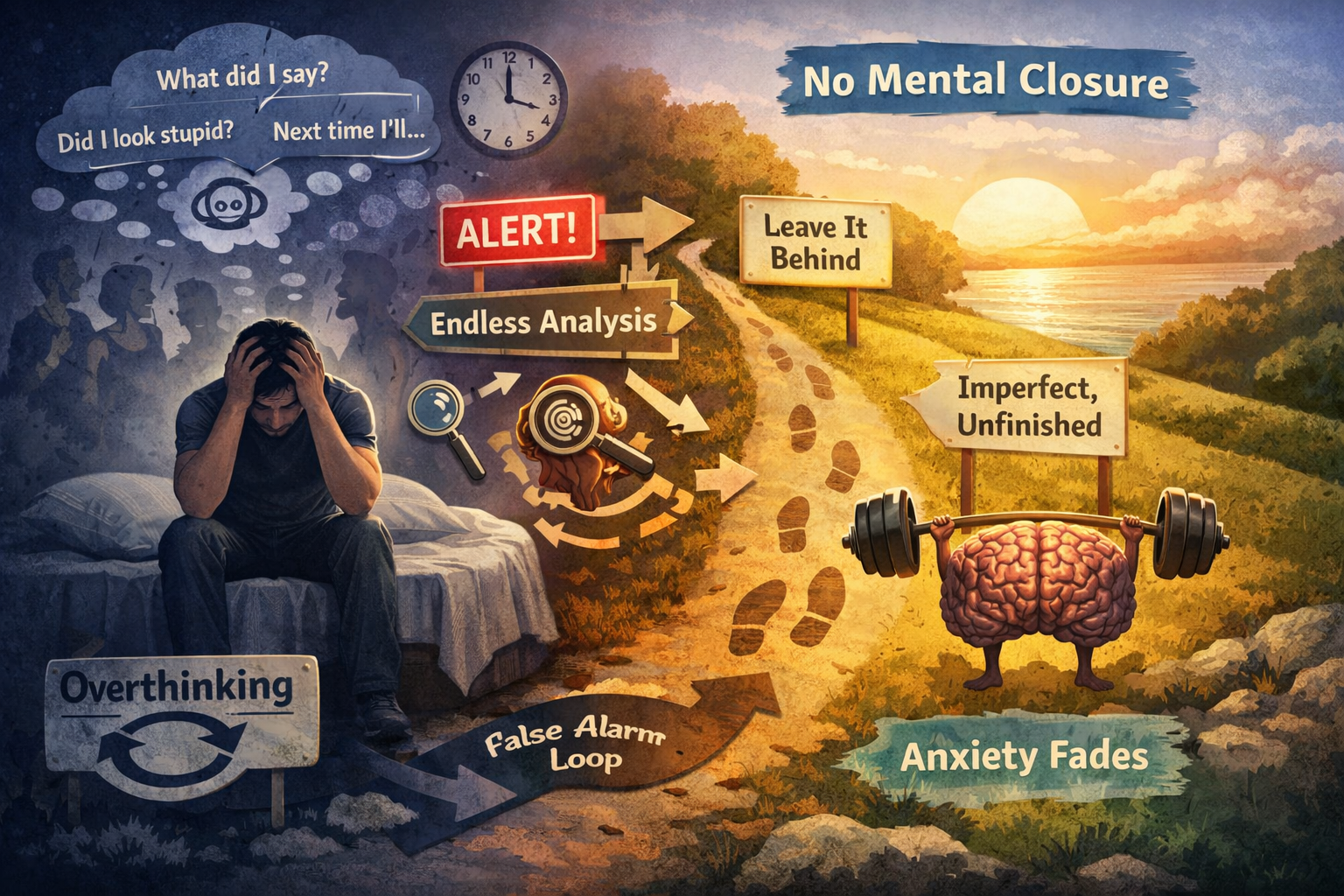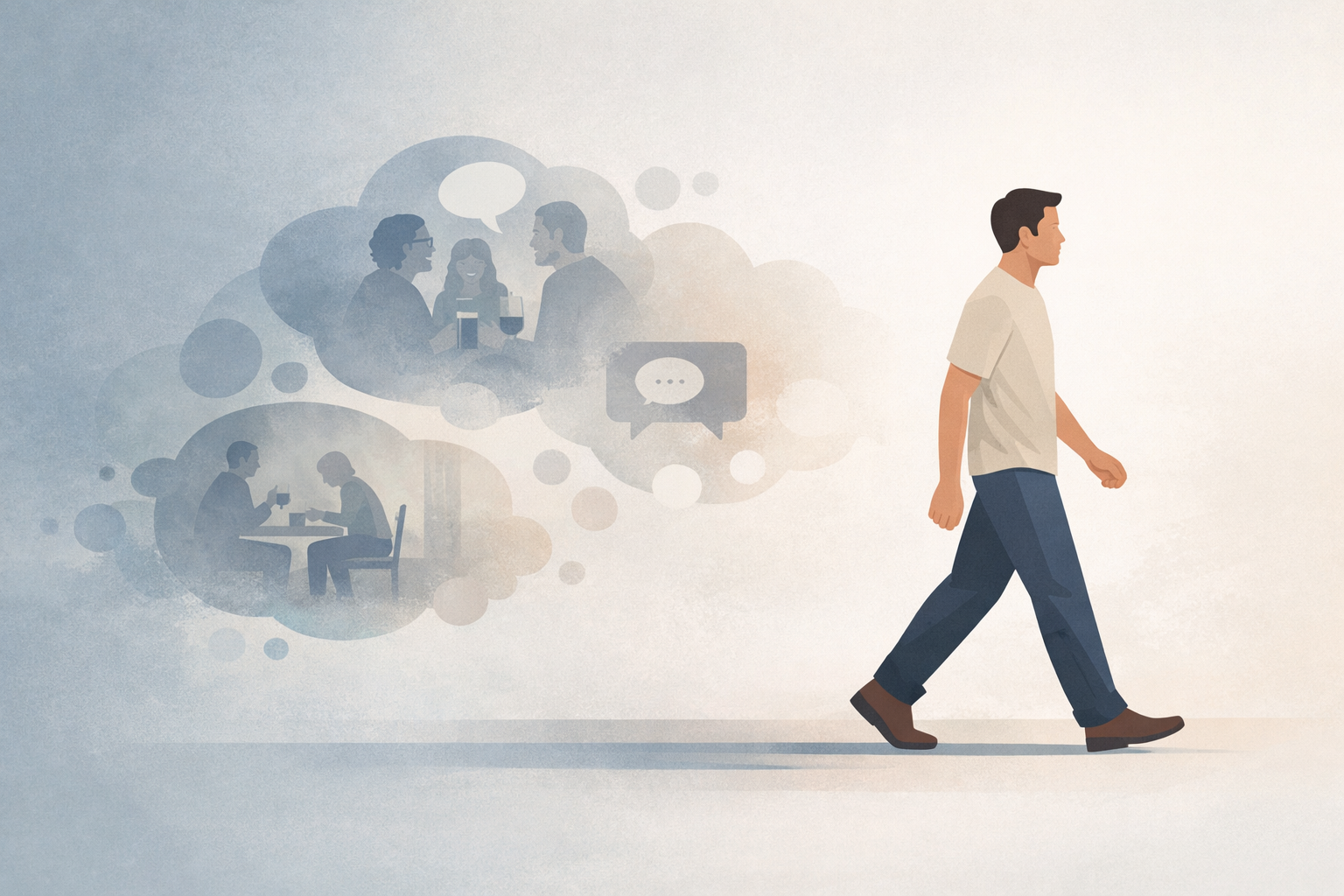

Anxiety recovery rarely follows a straight, steadily downward line. For many people in treatment, the process feels much messier. One week things improve; the next week anxiety spikes again. When that happens, it’s easy to assume the worst: “I must be getting worse.”
But cognitive behavioral therapy (CBT) and modern exposure science suggest a different explanation.
Sometimes what feels like regression is actually a recalibration phase — a period where the brain is updating its threat prediction system.
Understanding this process can transform how people interpret temporary increases in anxiety during treatment.
A Familiar Scenario in Anxiety Treatment
Imagine someone working through anxiety using CBT or exposure therapy.
They begin:
- Reducing reassurance-seeking
- Stopping constant rumination
- Facing feared situations they previously avoided
For example:
- A person with social anxiety begins attending meetings without rehearsing every sentence beforehand.
- Someone with generalized anxiety disorder (GAD) practices postponing worry instead of mentally solving every possible future problem.
At first, anxiety increases.
Their thoughts might sound like:
- “This is worse than before.”
- “Therapy is making me more anxious.”
- “I’m clearly regressing.”
But what is actually happening is often something else entirely.
The brain is recalibrating.
The Brain’s Threat System Is Updating
At the core of anxiety is the brain’s threat prediction system, which includes structures like the amygdala and related networks involved in learning and memory.
For years, the brain may have learned rules such as:
- “Social mistakes are dangerous.”
- “Uncertainty must be solved immediately.”
- “If I worry enough, I’ll prevent bad outcomes.”
These beliefs are reinforced through avoidance and safety behaviors, including:
- Rumination
- Reassurance seeking
- Checking
- Avoidance of feared situations
From the brain’s perspective, these behaviors appear to “work” because anxiety temporarily decreases.
But CBT reveals that these strategies actually maintain anxiety over time.
Avoidance Learning vs Exposure Learning
Anxiety disorders are heavily shaped by learning processes.
Two types of learning dominate the system:
Avoidance Learning
Avoidance behaviors teach the brain:
- “The situation was dangerous.”
- “Avoiding it kept me safe.”
Examples include:
- Leaving a social event early
- Mentally rehearsing conversations for hours
- Reassuring yourself repeatedly
These actions provide short-term relief, which reinforces the behavior.
But they also prevent the brain from learning that the situation may actually be safe.
Exposure Learning
Exposure therapy works by creating new learning.
Instead of removing anxiety immediately, exposure allows the brain to experience:
- The feared situation
- The anxiety that comes with it
- The eventual realization that catastrophe does not occur
According to inhibitory learning theory, exposure creates new safety memories that compete with older fear memories.
Over time, the brain learns:
- “This situation is uncomfortable, but not dangerous.”
Why Anxiety Sometimes Increases During Progress
During early stages of exposure or behavioral change, the system can temporarily become unstable.
Why?
Because old regulatory strategies are being removed.
For example, when someone stops rumination or reassurance-seeking, they are essentially removing the brain’s previous anxiety stabilizers.
These stabilizers were artificial.
But the nervous system had grown accustomed to them.
Without them, the system briefly becomes more reactive.
This is the recalibration phase.
Prediction Errors: The Engine of Anxiety Recovery
Exposure therapy works through something called a prediction error.
A prediction error occurs when:
- The brain expects danger
- But the expected outcome does not occur
Example:
Prediction:
“I will embarrass myself and people will judge me.”
Outcome:
The meeting ends normally.
Each mismatch between prediction and reality updates the brain’s internal model.
But this updating process requires repeated experiences.
One exposure rarely changes the system completely.
Instead, the brain gradually revises its threat predictions through accumulated evidence.
Why the Anxious Brain Misinterprets Discomfort as Failure
Anxiety disorders train the brain to treat any discomfort as evidence of danger.
So when anxiety spikes during treatment, the brain interprets it as:
- “Proof that something is wrong”
- “Proof that the strategy isn’t working”
But anxiety intensity alone is not a reliable indicator of progress.
In fact, effective exposure often involves temporary increases in anxiety.
This is because the brain is finally encountering the feared situation without avoidance.
Rumination and Reassurance: Artificial Stability
Many people with anxiety unknowingly regulate their nervous system through:
- Mental problem solving
- Excessive worry
- Seeking reassurance
- Checking behaviors
These strategies can temporarily lower anxiety.
But they also prevent corrective learning.
Research on generalized anxiety disorder (Borkovec) suggests that worry functions as a cognitive avoidance strategy that prevents emotional processing.
When people stop these habits, anxiety can temporarily rise because the nervous system is no longer buffered.
But this allows deeper recalibration to occur.
How the Amygdala Updates Threat Predictions
The amygdala plays a central role in detecting and responding to perceived threats.
Exposure therapy helps update this system through repeated experiences that demonstrate:
- The feared outcome does not occur
- Anxiety naturally decreases over time
- The individual can function even while anxious
Through repetition, the brain begins to encode new inhibitory memories.
These memories do not erase fear entirely.
Instead, they allow the brain to access multiple interpretations of a situation.
This creates flexibility, which is the hallmark of recovery.
Recalibration vs Real Relapse
Not every increase in anxiety indicates a relapse.
Many increases are part of the learning process.
Here are markers that suggest recalibration rather than regression:
Signs of Recalibration
- Anxiety spikes but recovery happens faster
- Rumination episodes become shorter
- You continue functioning despite anxiety
- Avoidance behaviors are decreasing
- You engage with feared situations even when uncomfortable
Signs of True Relapse
- Avoidance increases again
- Rumination dominates most of the day
- Functioning significantly decreases
- Exposure and behavioral changes stop entirely
The difference lies not in the presence of anxiety, but in behavioral patterns.
Why Progress Feels Counterintuitive
One of the hardest parts of anxiety treatment is that progress often feels uncomfortable.
Many people expect recovery to mean:
- Gradually feeling calmer
- Experiencing less anxiety every day
But in reality, progress often looks like:
- Feeling anxious but still acting
- Recovering faster after stress
- Spending less time trapped in worry loops
In CBT, success is often measured by:
- Behavioral flexibility
- Tolerance of uncertainty
- Speed of emotional recovery
Not by the complete absence of anxiety.
Examples of Recalibration in Different Anxiety Disorders
Social Anxiety
Someone begins attending social events without rehearsing conversations.
Initially:
- Anxiety spikes
- Self-conscious thoughts increase
But over time:
- Conversations flow more naturally
- Post-event rumination decreases
- Confidence slowly increases
Generalized Anxiety Disorder
Someone practices postponing worry instead of engaging with every anxious thought.
Initially:
- Anxiety feels stronger
- The urge to solve problems increases
But eventually:
- Worry episodes shorten
- Mental space expands
- Uncertainty becomes easier to tolerate
The Bigger Picture: Anxiety as a Learning System
CBT views anxiety not as a permanent flaw, but as a learning system that can be updated.
Through exposure, behavioral experiments, and cognitive restructuring, the brain gathers new data about the world.
This process takes time.
And during that time, the system may temporarily fluctuate.
But those fluctuations often signal learning in progress.
Conclusion: Recalibration Is a Sign of Change
Experiencing a temporary increase in anxiety during treatment does not automatically mean something is wrong.
Often it means the opposite.
It means the nervous system is letting go of old regulatory habits and updating its threat model through new experiences.
This recalibration phase can feel uncomfortable and confusing.
But persistence through it allows the brain to develop more accurate predictions, greater flexibility, and more durable anxiety reduction.
In other words:
You’re not regressing.
Your brain is learning.
References
Borkovec, T. D., Alcaine, O., & Behar, E. (2004). Avoidance theory of worry and generalized anxiety disorder.
Clark, D. M., & Wells, A. (1995). A cognitive model of social anxiety disorder.
Craske, M. G., et al. (2014). Maximizing exposure therapy: An inhibitory learning approach.
Foa, E. B., & Kozak, M. J. (1986). Emotional processing of fear: Exposure to corrective information.
Hofmann, S. G. (2008). Cognitive processes during fear acquisition and extinction in anxiety disorders.