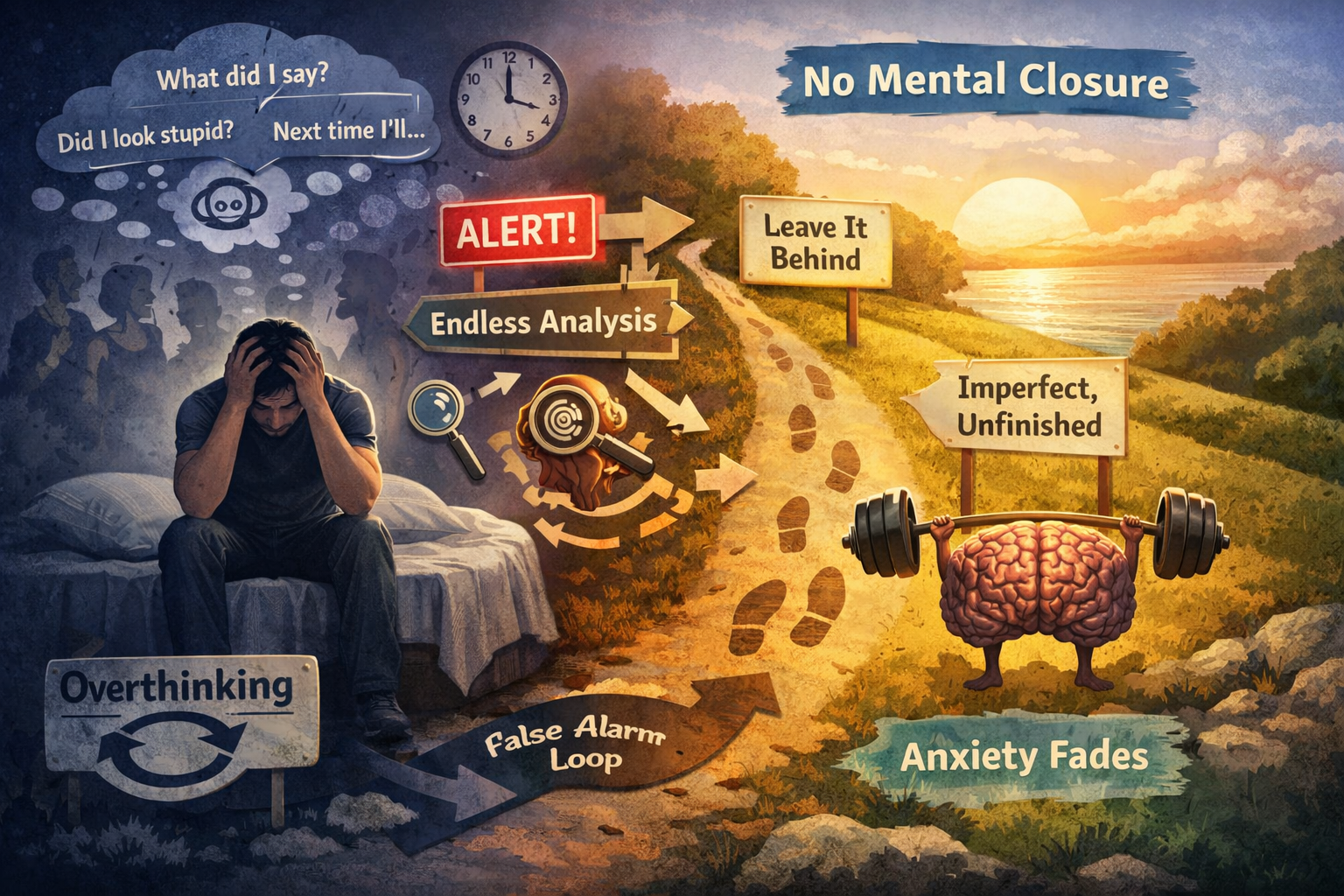

Anxiety often feels disproportionate to what is happening in the present moment.
A brief moment of criticism can trigger hours of rumination. A small mistake may produce intense shame. Hearing others laugh in a social setting can suddenly create a wave of self-consciousness or fear of rejection.
For many people struggling with anxiety disorders, these reactions are confusing because the current situation does not seem dangerous enough to justify the emotional intensity.
Modern psychological research suggests that these reactions often occur because the brain is not responding only to the present moment. Instead, it is responding to earlier emotional learning stored in memory networks related to safety, belonging, and evaluation.
What many therapeutic approaches refer to as “inner child work” is essentially the process of identifying and updating these early emotional learning patterns. Rather than focusing on reliving the past, the goal is to help the nervous system learn that present situations are different from earlier experiences that originally shaped these reactions.
Understanding how this process works can make anxiety responses feel far less mysterious, and far more changeable.
How Early Emotional Learning Shapes Anxiety
During childhood and adolescence, the brain is constantly learning patterns about how the social and emotional world works.
Children learn:
- Whether mistakes are safe or dangerous
- Whether expressing emotions leads to comfort or criticism
- Whether rejection is likely or unlikely
- Whether the environment feels predictable and supportive
These repeated experiences gradually shape emotional expectations about the world.
When certain experiences occur repeatedly, such as harsh criticism, unpredictable reactions from caregivers, bullying, or emotional invalidation, the brain may learn patterns like:
- “Mistakes lead to rejection.”
- “People will judge me if I speak.”
- “It is safer to stay quiet.”
- “Conflict means something bad will happen.”
These patterns are not simply beliefs. They become emotionally encoded learning stored within memory networks that influence how the brain interprets new situations.
Over time, these learning patterns can contribute to anxiety disorders when the brain begins to treat everyday social or performance situations as potential threats.
Schemas and Emotional Memory
In cognitive and schema-focused therapies, these early learning patterns are often described as schemas.
Schemas are mental frameworks that organize how we interpret experiences. They guide attention, expectations, and emotional reactions.
Schemas related to anxiety commonly involve themes such as:
- Rejection
- Shame
- Failure
- Social evaluation
- Lack of safety or control
These schemas develop gradually through repeated emotional experiences, especially during early developmental years when the brain is particularly sensitive to social feedback.
Two important psychological mechanisms help explain how schemas influence anxiety.
Emotional Memory
Emotional memories are stored differently from neutral memories. Experiences that involve strong feelings, especially fear, shame, or rejection, are encoded in brain systems involving the amygdala and hippocampus.
Because these systems prioritize threat detection, emotional memories can be reactivated quickly when similar situations occur later in life.
For example:
- Being laughed at in school may increase sensitivity to social laughter later in life.
- Being criticized harshly for mistakes may increase anxiety when receiving feedback at work.
Pattern Recognition
The brain constantly scans the environment for patterns that resemble past experiences.
When it detects something that resembles earlier emotionally significant events, it may trigger the same response pattern, even if the current situation is much safer.
This is why anxiety responses often feel automatic and difficult to control.
Why Certain Triggers Activate Strong Anxiety
Many common anxiety triggers share characteristics with earlier emotionally meaningful experiences.
Examples include:
- Social evaluation (presentations, meetings, group discussions)
- Criticism or feedback
- Making mistakes
- Perceived rejection
- Being the center of attention
These situations can activate schemas related to shame, rejection, or failure.
Once activated, the nervous system may respond with:
- Increased heart rate
- Hypervigilance to social cues
- Rumination about possible mistakes
- Avoidance behaviors
- Self-critical thoughts
Importantly, these reactions occur before conscious reasoning has time to evaluate whether the situation is actually threatening.
The brain is responding based on emotional learning rather than objective analysis.
This is one reason anxiety can feel difficult to control using logic alone.
What “Inner Child Work” Means in a Psychological Context
In popular culture, the term “inner child” is sometimes misunderstood.
In evidence-informed psychological practice, the concept refers to early emotional learning systems that were formed during childhood and continue to influence reactions in adulthood.
Inner child work therefore involves:
- Recognizing earlier emotional patterns
- Understanding how they influence present reactions
- Creating new emotional learning experiences that update those patterns
This process does not involve endlessly analyzing childhood or blaming past experiences.
Instead, it focuses on how the brain learns and updates emotional responses.
Several therapeutic approaches incorporate this process.
Cognitive Behavioral Therapy (CBT)
CBT helps identify thought patterns and behavioral responses linked to anxiety.
Through cognitive restructuring and behavioral experiments, individuals gradually test new interpretations of situations that previously triggered anxiety.
Schema Therapy
Schema therapy focuses more directly on early emotional learning patterns.
It helps individuals recognize schemas related to shame, rejection, or vulnerability and develop healthier responses to these triggers.
Exposure Therapy
Exposure therapy plays a crucial role in updating emotional learning.
By gradually encountering anxiety-provoking situations in safe contexts, the brain learns that previously feared outcomes are less likely or less dangerous than expected.
The Science of Updating Emotional Learning
Recent research in neuroscience helps explain why these therapeutic approaches are effective.
Memory Reconsolidation
When an emotional memory is activated, it briefly becomes malleable.
During this window, new experiences can modify the emotional meaning associated with the memory.
If a previously threatening situation is experienced with safety, support, or competence, the brain may update its prediction about that situation.
Over repeated experiences, the anxiety response gradually weakens.
Nervous System Regulation
Therapy also helps individuals develop skills that regulate the nervous system.
These may include:
- Breathing techniques
- Grounding exercises
- Emotional awareness
- Self-compassion practices
Regulation helps the brain remain in a learning state rather than a threat state, which makes it easier to update emotional patterns.
Schema Updating
As individuals repeatedly encounter situations that contradict their expectations, schemas can gradually change.
For example:
- “If I make a mistake, people will reject me” may shift toward “Mistakes are uncomfortable but manageable.”
This change rarely happens instantly. It develops through repeated corrective experiences over time.
Practical Therapeutic Principles in Updating Emotional Patterns
Although therapeutic approaches vary, several common principles are involved in updating emotional learning.
1. Recognizing Emotional Patterns
The first step is identifying recurring triggers and reactions.
Questions often explored in therapy include:
- When does anxiety increase most strongly?
- What emotions accompany the anxiety?
- What thoughts or fears appear in those moments?
Recognizing these patterns helps reveal underlying schemas.
2. Activating Emotional Memories Safely
Therapy sometimes involves discussing or reflecting on earlier experiences related to current triggers.
The goal is not to relive distressing experiences but to understand how earlier learning shaped current reactions.
This process allows emotional patterns to become visible rather than automatic.
3. Pairing Triggers with New Experiences
One of the most powerful ways to update emotional learning is to encounter triggers in contexts that produce different outcomes.
Examples include:
- Speaking in social situations and discovering that mistakes are tolerated
- Receiving feedback that is constructive rather than rejecting
- Expressing emotions and experiencing understanding instead of criticism
These experiences gradually change the brain’s predictions about threat.
4. Building Internal Self-Support
Many therapeutic approaches emphasize developing internal responses that counter earlier patterns of shame or fear.
This may include:
- More balanced self-talk
- Compassion toward personal mistakes
- Realistic interpretations of social situations
- Confidence in coping abilities
Internal support reduces the likelihood that anxiety spirals into rumination.
How This Process Reduces Anxiety
As emotional learning updates, several important changes often occur:
- Reduced sensitivity to social evaluation
- Faster emotional recovery after stressful events
- Decreased rumination about mistakes
- Less automatic self-criticism
- Increased sense of emotional safety
These changes are particularly relevant in conditions such as:
- Social anxiety disorder
- Generalized anxiety disorder
- Perfectionism-related anxiety
Over time, the nervous system becomes less likely to interpret everyday situations as threats.
The Goal Is Not Eliminating Emotions
An important misconception about anxiety treatment is the idea that therapy aims to eliminate difficult emotions.
In reality, emotions such as embarrassment, uncertainty, and concern are normal parts of human experience.
The goal of therapeutic work involving early emotional learning is different.
It is about helping the brain learn that current situations are not the same threats that earlier experiences may have taught it to expect.
When emotional learning updates, anxiety becomes more proportional to the present moment rather than shaped by outdated patterns from the past.
This shift allows individuals to respond to life’s challenges with greater flexibility, confidence, and emotional balance.
References
Beck, A. T., & Clark, D. A. (1997). An information processing model of anxiety: Automatic and strategic processes. Behaviour Research and Therapy.
Young, J. E., Klosko, J. S., & Weishaar, M. (2003). Schema Therapy: A Practitioner’s Guide. Guilford Press.
Lane, R. D., Ryan, L., Nadel, L., & Greenberg, L. (2015). Memory reconsolidation, emotional arousal, and the process of change in psychotherapy. Behavioral and Brain Sciences.
Craske, M. G., et al. (2014). Maximizing exposure therapy: An inhibitory learning approach. Behaviour Research and Therapy.
LeDoux, J. (2015). Anxious: Using the brain to understand and treat fear and anxiety. Viking.